


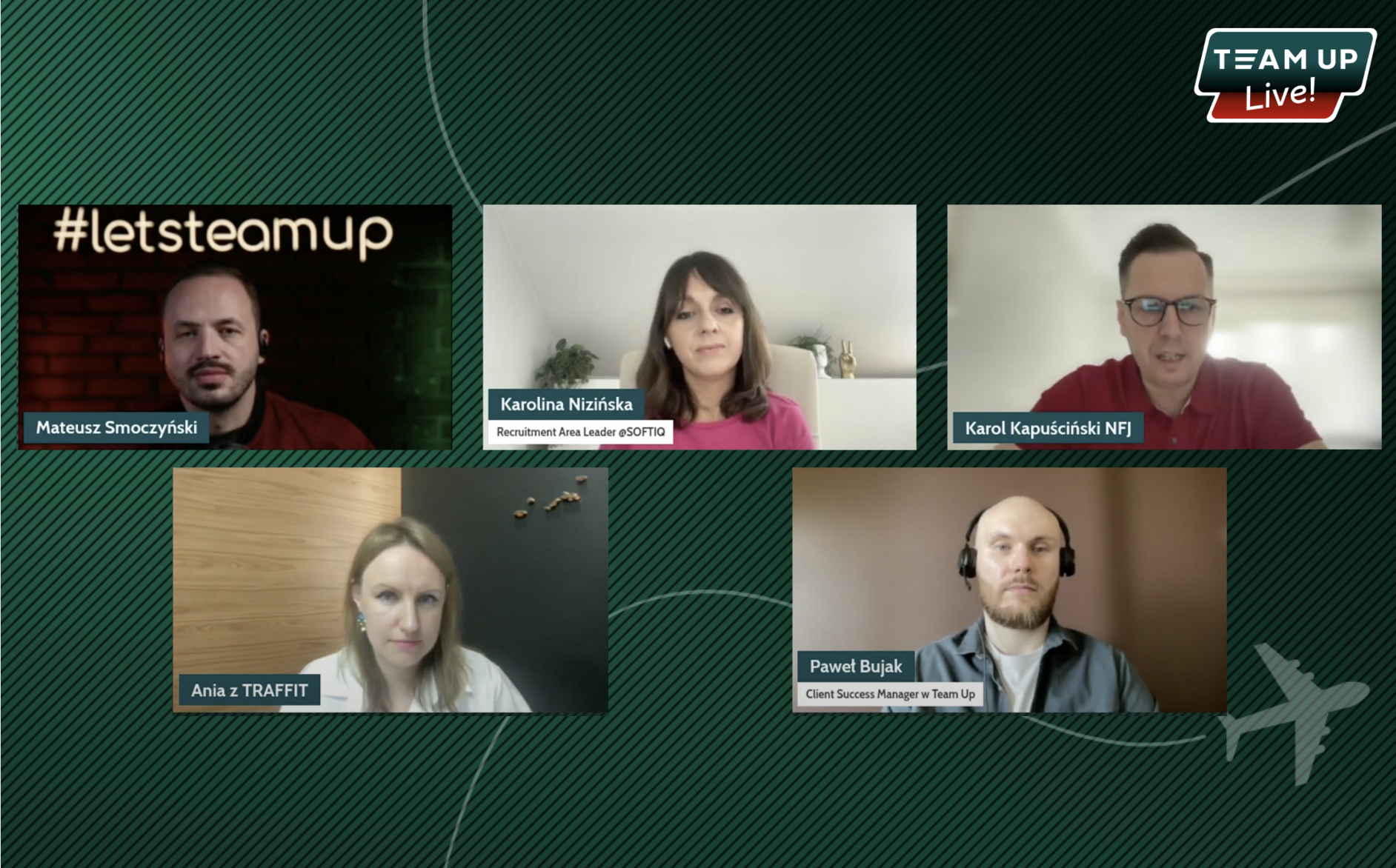
To verify our observations, we invited industry experts to the eighth episode of Team Up Live – allowing us to examine the situation from multiple perspectives: ATS platforms, job boards, software houses, and recruitment agencies. Our goal was to find out whether we are truly witnessing a revival in the IT job market or just an illusion. In this article, we aim to analyze the current state of the IT job market in Poland, drawing on hard data and insights from key industry players.
In the article below, we will discuss:
1. The first signs of a rebound – what do the data from ATSs and job boards say?
2. How has the operating model of software houses changed?
3. What is the new role of IT recruitment agencies?
4. Are we seeing a renewed interest in Polish specialists for IT projects?
5. What does the current candidate market look like?
6. Three factors that sparked the revival of the IT market.
Early signs of recovery? Let’s look at the data
When discussing the state of the IT job market, gut feelings or isolated stories aren’t enough. Numbers speak loudest – and we’ve gathered them from two key sources: the ATS system Traffit (widely used by companies and recruitment agencies) and the job board NoFluffJobs.
More job openings, but cautious hiring
In the first quarter of 2025, the number of new recruitment processes increased by 21% compared to the same period last year (according to data from Traffit). That’s a clear signal – companies have resumed the search for IT specialists. However, actual hires went up by only 8%, indicating that while employers are reopening to recruitment, they’re proceeding with great caution.
“Companies are hiring more cautiously. The era of overhiring or filling up project benches seems to be over. Today, every vacancy is carefully considered and driven by a specific, urgent need.”
Anna Sykut, Product Marketing Manager Traffit
More candidates, but lower quality
While the number of job postings is growing, the alignment between candidates and job requirements has worsened. Traffit data shows a decline in the percentage of applications successfully passing preselection – from 65% to 58% year-over-year. What’s behind this shift? Candidates are returning to the market, but many are applying less selectively, simply hoping to improve their employment situation.
“Ghost jobs” – a real issue or a side effect of business models?
“Ghost jobs” – listings posted without a real intent to hire – are, at least in part, a byproduct of new job board business models. These models often allow unlimited postings for a fixed fee, which can create the illusion that there are more genuine opportunities than there actually are.
“Some employers publish the same job ad under different titles to reach various candidate groups. This doesn’t always mean they’re ready to hire quickly — sometimes they’re just testing the market or waiting for the perfect candidate.”
Karol Kapuściński, Head Of Growth No Fluff Jobs
While the data clearly points to a rebound, the IT industry today is far more careful than just a few years ago. Whether this is the beginning of a new era or just a temporary improvement remains to be seen in the coming months.
Software houses emerging stronger from the crisis?
Among all segments of the IT industry, software houses were the first to feel a positive shift. According to Traffit ATS data, the number of new recruitment processes in software houses grew by over 20% in Q1 2025 compared to the same period last year. These companies are actively rebuilding their teams – but they’re doing it very differently than before.
“In just the first quarter of this year, we’ve already hired over a dozen new people. It’s a clear sign that the market is waking up – and not only on the commercial client side. The public sector is becoming increasingly active as well.”
Karolina Nizińska, Recruitment Area Leader SOFTIQ
The most significant transformation is the evolution of the software house business model. Instead of traditional outsourcing – essentially “renting out” developers – these companies are now positioning themselves as strategic partners. An increasing number of projects focus on advanced technological solutions such as:
- AI development and business process automation
- Designing and implementing cybersecurity systems and conducting IT audits
- Creating long-term tech strategies and developing innovative digital products
In short, software houses are no longer just “coding on demand.” They are becoming key technology partners, helping clients grow their businesses – both locally and on the global stage.
The new role of IT recruitment agencies: tougher roles, more consulting
After months of being pushed into the background, IT recruitment agencies are back in action. Talent acquisition specialists are now busier than ever. According to data from Team Up, the number of recruitment projects in Q1 2025 increased by 31% year-over-year.
“There are definitely more projects – but their nature has changed. These are no longer straightforward vacancies that companies could easily fill on their own. Now, agencies are mainly handling challenging recruitments that require specialized skills, experience, and access to niche candidates.”
Paweł Bujak, Client Success Manager Team Up
Many of today’s recruitment projects are for roles that blend technology and business, requiring rare and highly specialized competencies, such as:
- experts in niche technologies
- hybrid positions combining technical and business expertise
- specialists and managers for R&D and product development teams
For recruitment agencies, this shift means delivering much more than just a shortlist of CVs. Recruiters are now expected to offer expert-level consulting, work closely with hiring managers, and most importantly – understand the business needs of the client in order to match them with the best talent on the market.
Some recruitments require not only a flawless process, but also a deep understanding of industry specifics, niche communities, and real-world tech context. This is particularly true in Web3 or gamedev projects – where classic sourcing strategies often fail, and success depends on one’s network, domain expertise, and the ability to spot potential beyond what’s on a CV.
How to recruit in Web3? Challenges and tips for recruiters
Recruiting in GameDev – how to find top talent for game development projects
Poland is once again attracting global tech companies
Not long ago, it seemed like Poland’s position as a hub for IT services was weakening. Many companies were moving their tech teams to Asia or Southern Europe in search of lower costs. However, that trend is starting to reverse.
“Companies that had previously moved their teams to lower-cost countries are now starting to return. Poland still offers one of the best price-to-quality ratios for IT specialists in the world.”
Karol Kapuściński, Head Of Growth No Fluff Jobs
Currently, Poland is receiving an increasing number of inquiries not only from Germany and the Nordics, but also from Israel, India, Middle Eastern countries (e.g. the UAE), and the United States. However, these are very different projects compared to a few years ago. They are predominantly focused on:
- advanced research and development (R&D)
- tasks requiring unique, highly specialized expertise
- projects involving artificial intelligence (AI), data analytics, and advanced systems engineering
“Poland is facing a unique opportunity – we can move beyond being seen merely as a hub for shared service centers (SSCs) and start positioning ourselves as a strategic technology and R&D hub. It all depends on how we seize this opportunity.”
Paweł Bujak, Client Success Manager Team Up
Candidate market is picking up – but selection hurts
The IT candidate market in 2025 has indeed come back to life. After two years of slowdown and caution, more and more professionals are actively exploring new opportunities. This trend is especially noticeable among mid-level and senior specialists, who – often tired of stagnation or lack of raises – are now open to change. Junior candidates, however, are still facing an uphill battle.
But more activity doesn’t necessarily translate into better hiring outcomes for employers. On the contrary – finding the right candidate is becoming even harder, as the growing volume of applications makes it increasingly difficult to identify the perfect match.
“A single junior-level job posting can attract as many as 1,500 CVs. No recruiter can realistically go through them all. That’s why direct outreach and relationship-building have become more important than ever.”
Karolina Nizińska, Recruitment Area Leader SOFTIQ
Adding to the challenge is the growing number of candidates applying “just in case,” hoping for a lucky break. This results in lower application quality and poor match with job requirements – ultimately slowing down and complicating hiring processes on both sides.
How to job hunt effectively in IT in 2025?
The IT job market may be regaining momentum, but it’s no longer enough to simply click “Apply” and wait for a call. To stand out today, strategy, intentionality, and quality matter more than ever. Here’s what our experts recommend:
1. Apply selectively, not in bulk
A scattershot approach rarely works anymore. Sending the same CV to 30 companies a day is ineffective. Instead, choose 5 truly relevant offers and tailor your application carefully.
2. Tailor your CV to each job
Recruiters quickly notice whether a candidate has actually read the job ad. Stand out by showing fit – highlight specific technologies, achievements, and context relevant to that particular company.
3. Build relationships before the job is posted
Many top candidates land roles through relationships, not job boards. That’s why it pays to:
- reach out to recruiters in advance
- follow company profiles
- attend webinars
- leave thoughtful comments on social posts
Direct engagement is now one of the biggest competitive advantages in the job market.
4. Don’t ignore assignment tasks – show you care
Even if you think the task is “pointless,” do it anyway. It doesn’t have to be perfect – what matters is that you deliver something. It’s often the first tangible proof of your motivation and work ethic.
The takeaway?
In 2025, quality beats quantity. Candidates who know how to play the game strategically have a clear edge. And companies that recruit with intention attract those very candidates.
What’s driving the IT market recovery?
The thaw in the IT job market didn’t happen by accident. During Team Up Live #8, our experts pointed to three key factors pushing the industry back toward growth:
1. Teams are being rebuilt after cautious layoffs
Over the past two years, many organizations conducted “preventive layoffs” — cutting staff just in case things got worse. Now, it turns out that some of those cuts were too aggressive. Companies are starting to rebuild, but they’re doing it carefully, with tighter control and real project needs in mind.
2. Regulatory and funding pressure is accelerating digitalization
Companies aren’t digitizing out of sheer enthusiasm – they’re being forced to. External pressures are mounting and impossible to ignore. The most significant include:
- New EU regulations, such as NIS2 (cybersecurity), AI Act (artificial intelligence), and eIDAS 2.0 (digital identification)
- EU and KPO funding, which often comes with strict technological requirements
- The growing need for automation and process optimization, driven by cost pressures and talent shortages
These are not passing trends – they are real mandates, and they all point to the same conclusion: companies must invest in technology, which in turn increases demand for IT talent.
3. Delayed digital transformation
Despite years of talking about digitalization in Poland, many organizations are still stuck with outdated systems and manual processes – especially in SMEs and the public sector, where tech investments were often postponed.
The result? Many businesses are now facing a serious tech debt – lacking capabilities in data, AI tools, and process automation. On the one hand, this is a systemic challenge. On the other, it’s a huge opportunity for tech providers and IT professionals who can deliver transformative solutions, integrate tools, and bring real efficiency to organizations.
IT recruitment in 2025: less hype, more substance
Are we going back to the 2022 market, where job offers were flooding in and candidates could browse roles like a Netflix catalog? Definitely not. But that doesn’t mean we’re standing still.
IT recruitment in 2025 is maturing. It’s more thoughtful, purposeful, and grounded in real business needs. Companies are hiring again – but more wisely. Candidates are applying again – but more cautiously. Agencies are working again — but with a focus on quality, not quantity.
“This is the beginning of a transformation. If we play it right, everyone stands to benefit – companies, candidates, and the recruitment industry alike.”
Paweł Bujak, Client Success Manager Team Up
The rebound we’re seeing might not just be a brief moment of relief — but the start of an entirely new phase. One where recruitment becomes more collaborative, the market more balanced, and Poland increasingly recognized as a hub of expertise rather than just a source of cheap labor.
Want the full picture and to hear how the situation looks from the perspective of ATS providers, job boards, software houses, and recruitment agencies? The recording of our discussion in Polish is now available on YouTube.
![IT recruitment in crisis – what can a Recruiter do to weather the storm? [REPORT]](https://teamuprecruitment.com/wp-content/uploads/2025/11/zrzutekranu2024-06-24o09.37.35-1024x759-optimized.png)

 7 MIN
7 MIN
