


Artificial intelligence will not replace recruiters, but it will automate selected stages of the recruitment process. According to Market Research Future data, approximately 87% of companies globally are already using AI in recruitment — primarily for automated resume screening, candidate scoring, and automated follow-up messaging. However, the technology faces significant limitations: low acceptance among passive candidates, legal requirements (GDPR, EU AI Act), and the fact that the most sought-after IT specialists expect human contact. Recruiters who ignore new tools lose their competitive advantage — just as with previous waves of technology (ATS, LinkedIn, chatbots). AI is transforming the recruiter’s role, but not eliminating it.
15:20Below, I break this down piece by piece – drawing on 18 years of personal experience in IT recruitment and a specific case study from Zapier, which has just published the results of its pilot program with an AI-powered recruiting tool.
Artificial intelligence in IT recruitment – another revolution that was going to change everything
There’s a lot of talk about AI “taking over recruitment.” Some treat it as a threat, others get excited like kids on Christmas morning. And the reality, as is usually the case, is far more complex and nuanced than the media headlines suggest.
I’ve been working in IT recruitment for 18 years. In that time, I’ve witnessed several technological revolutions that were supposed to “change everything” — from applicant tracking systems, through new LinkedIn functionalities, to various generations of recruiting chatbots. Each of them changed something, but none ultimately eliminated the recruiter’s role. What they did eliminate, however, were the recruiters who chose to ignore them.
So instead of reading tea leaves, I want to tell you what I’m currently seeing in the market. Partly from the perspective of an observer, partly from the perspective of a practitioner who runs IT recruitment agency Team Up Recruitment and day-to-day recruits IT specialists for tech and product companies.
WORTH KNOWING!
According to market reports based on data from Market Research Future, approximately 87% of companies globally are already using some form of artificial intelligence in the recruitment process – for example for automated resume screening, candidate scoring, and automated follow-up messaging.
Two directions of recruitment automation in IT: sourcing vs. screening
When looking at how companies approach automating their recruitment processes, two main directions can be identified:
1. Sourcing automation – promising, but with clear limitations
The first area companies are trying to implement in IT recruitment is sourcing automation – the process of finding and acquiring candidates. Leading the way are AI recruitment tools such as Juicebox (Y Combinator-backed), Pin, and MetaView. They come with solid PR, hefty valuations, and genuinely growing adoption – primarily in the US market.
And this is where the first problem emerges: the United States is not Europe. AI-powered hiring tools operate by aggregating personal data from various sources – scraped web content, purchased lists, public profiles. In Europe, we have GDPR. And this is not merely a bureaucratic bogeyman – it’s a real problem for any company that cannot answer a candidate’s question: “Where did you get my data from?” In Polish or Western European enterprise environments, no compliance team will let something like that slide without raising an eyebrow.
The second problem was aptly identified some time ago by Agnieszka Rachwalak, a sourcing expert, in her LinkedIn post: AI recruitment automation tools focus exclusively on a single stage – sourcing, meaning the search itself. Meanwhile, sourcing is not just “find a profile.” It’s about making contact, sparking interest, convincing someone who isn’t actively looking for a job today to even have a conversation.
And in this element, despite all automation efforts, the human still wins. At least for now.
“Recruiters are needed again, and more and more job offers are appearing for sourcers. And not for juniors who will send messages blindly. The responsibilities include a strategic approach to recruitment, being a business partner. I look at these changes with hope, because recruitment is becoming a key business aspect. And this is not just HR experts talking on LinkedIn – these are real market demands.”
– Agnieszka Rachwalak, recruiter at Sonalake and trainer at Super Source Me
2. Candidate screening automation – Zapier and AI case study
The second area is automating the first stage of candidate conversations – the so-called screening interviews. And here we have an excellent case study to discuss. Zapier, a company specializing in automating workflows between applications, has just published the results of its pilot with an AI recruiter. I learned about this case study from the excellent newsletter by Jacek Krajewski, who consistently tracks what’s happening at the intersection of AI and HR (I highly recommend following him).
To understand the context: Zapier is a fully remote company that hires globally and, after posting a job opening, can receive thousands of applications within 48 hours. And up to 30% of them show signs of misrepresentation or are outright fraudulent – bots, fake identities, AI-assisted candidates so heavily optimized that they look great on paper but struggle with basic questions in practice.
This is a problem that is becoming increasingly common in IT recruitment. Fake candidates and recruitment fraud are not a conspiracy theory – they are a real challenge that HR departments are already dealing with right now. Both recruitment agencies and in-house TA teams alike.
What did Zapier do? They implemented an AI agent built on the Ezra AI Labs platform, which conducts the first screening with candidates. An important distinction: unlike typical AI chatbot recruiting solutions that merely answer FAQs, this is a full 15–20 minute conversation conducted by artificial intelligence, after which the recruiter receives a transcript, video clips, a summary, and a scoring – and only then makes a decision about moving forward in the recruitment process.
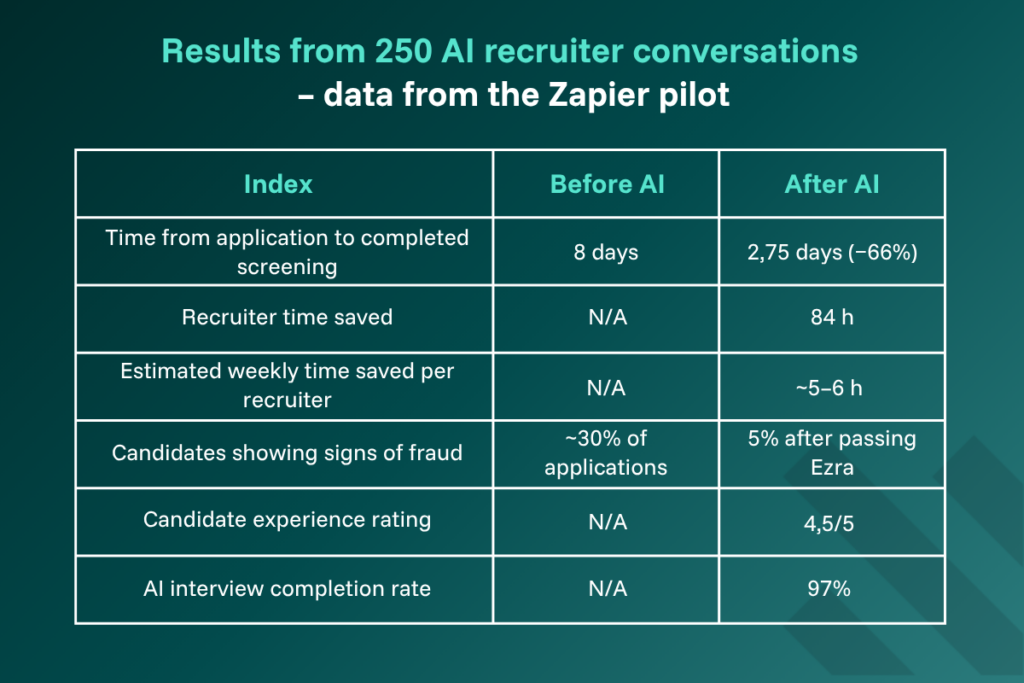
Results after a pilot of approximately 250 conversations?
The pilot ran for several months and covered approximately 250 AI-led screening interviews. The results surprised even Zapier’s own team – and on several fronts simultaneously.
Time-to-hire reduction from application review to completed screening dropped from 8 days to just under 3 – a 66% reduction. Recruiters reclaimed 84 hours over the course of the pilot, translating to an estimated 5–6 hours per recruiter per week if the system were running at full capacity. In the initial pilots for engineering roles, 30% of candidates who reached hiring managers were people who simply would not have had time to be reviewed in a traditional recruitment process.
And the most important number from a process security perspective: fake candidates dominated by bots and false identities simply did not complete the AI conversation. Only 5% of candidates passed through by Ezra (the AI recruiter) showed signs of fraud. The fraud detection mechanism therefore performed better than anyone had anticipated.
Candidate experience with AI recruiter interviews – what do the data say?
The results achieved sound impressive, however I want to be fully transparent: I have mixed feelings about the candidate satisfaction survey.
Zapier reports that 97% of candidates who began the AI recruiting chatbot conversation completed it. The average experience rating was 4.5 out of 5, and 86% of candidates gave 4 or 5 stars. Sounds like a complete success.
But wait. When exactly were these candidates asked for their rating? Immediately after the conversation? During the recruitment process, when they still hope to receive an offer?
Because from a psychological standpoint, a candidate’s response to the question “How would you rate our recruitment tool?” asked during the process carries a massive bias. Nobody who wants to get the job is going to give a low score to a tool being used by the company that is recruiting them.
I’m not saying the results are false. I’m simply saying it’s worth treating them with a degree of methodological caution – we don’t know at what stage of the recruitment process the AI bot conversation satisfaction was measured.
Opt-in and transparency – key conditions for implementing AI in recruitment
There is one more very important detail I want to highlight!
The entire system was fully opt-in. Candidates had to consent to being handled by artificial intelligence. And this is where an interesting problem begins: consent rates varied from 35% to 81% depending on the role. Zapier itself acknowledges that the key lies in how clearly and honestly we communicate to candidates why we are using such a tool. But even with highly transparent communication, there were positions where over 60% of candidates said: “No, thank you.”
And we are talking exclusively about active candidates – those who applied themselves and voluntarily entered the process. People who actually want to work there.
What does this mean for sourcing passive candidates? For those people that we at Team Up Recruitment reach out to when they are happy in their current role, not looking for a change, but might potentially be interested in something exciting? Imagine this scenario: I send a message to someone saying “Hey, I have an interesting opportunity from company X, worth a chat.” The candidate accepts the invitation, and in the next step reads: “Great, let me introduce you to our AI recruiting bot.” I think the opt-in rate in this scenario would drop dramatically.
AI in IT recruitment in 2026 – what already works, and what it still cannot replace
AI recruitment automation is today real and useful in a very specific context: where there is high volume of active candidates, elevated levels of fraud, and limited recruiter bandwidth. Large technology companies hiring globally, like Zapier, represent the ideal environment for such solutions.
However, it is worth stating clearly what it is not. We are definitely not yet in a situation where “AI replaces the recruiter.” This is artificial intelligence acting purely as a first filter, so that a human recruiter can focus on what delivers real value: talking to people, advising, building relationships, and evaluating things that no language model can yet assess. Things like ambition, potential, cultural fit, and motivation. And this is precisely where the human oversight AI recruitment principle comes in – the one Zapier talks about and which is, in my view, the only responsible way to implement AI in IT recruitment processes today. AI collects data, aggregates signals, filters out noise. But it is the human who ultimately decides.
Gartner analyst Helen Poitevin argues that only a small percentage of companies will reach the point where chatbots handle the majority of HR tasks. Even then, headcount reduction in HR will be minimal – below 5%. HR departments may in fact see an increase in headcount to manage bots that can behave unpredictably.
– Thibodeau, P. (2024, 4th November). Gartner: AI isn’t replacing HR workers. TechTarget.
Will AI take over more? That depends on the market, not the technology
Someone might say: but surely it’s only a matter of time before AI takes over more. Perhaps. But it’s worth remembering that if the job market does not transform into a dystopia of a few global corporations where desperate candidates will talk to anyone just to get a chance at joining the process – then for a long time there will remain a segment of recruitment where candidates will simply expect a human on the other side. Especially the top applicants – the ones everyone is competing for.
Relationship-based recruiting – the last stronghold resistant to automation
A candidate who is today a senior at a good company, doing well, not actively looking for a change but perhaps open to being interested in something truly compelling – such a person, if they are already giving up their time to discuss a new opportunity, expects that the person on the other side is genuinely giving their time in return. Not a bot that will shortly forward their transcript to an ATS. And this, in my view, is the space where the value of relationship-based recruiting – both agencies like Team Up Recruitment and strong in-house recruiters – will remain resistant to automation for a long time to come.
At least until AI truly learns to listen. And that, we will be waiting a little longer for.
Author: Mateusz Smoczyński
Co-founder at Team Up, technical recruitment expert, psychologist, and commentator on the phenomenon of fake candidates in recruitment. Since 2008, he has been supporting technology companies in scaling engineering teams. He also develops TalentShield, an HR Tech project focused on detecting suspicious applications and strengthening AI hiring compliance in recruitment processes.


 12 MIN


