



Startup agility doesn’t have to mean hiring chaos – yet 64% of young companies admit their first hires were misguided due to a lack of process. Based on the experience of Valeryia Aerova, Senior Recruiter at Revolut, we’ve compiled 7 key principles: from setting priorities with founders, through a dual-track approach that combines fast execution with building scalable processes, to the conscious role of AI in recruitment. The article also covers the most common startup mistakes: reactive hiring, chasing “unicorns,” and ignoring processes, and offers practical takeaways to help you move from firefighting to scaling your team with intention.
Table of contents:
1. The 7 key principles of startup recruitment
2. What works when everything’s on fire – practical takeaways
3. The most common recruitment mistakes in startups
4. Summary: from firefighting to intentional scaling
The 7 key principles of startup recruitment
1. Before you start hiring – define what really matters
In many startups, the first few months feel like constant firefighting: new clients, investor pressure, and an ever-growing list of tasks that “someone has to do.” In such an atmosphere, hiring decisions are often made impulsively — without a plan, a clear brief, or a real reflection on whether a given role truly adds value at that stage.
It’s no surprise that many young companies later face frustration: the team grows, but productivity and decision quality do not.
As Valeryia Aerova, Data Recruitment Lead at Revolut, explains, the first step in recruitment isn’t posting a job — it’s having a conversation:
“Sit down with the founders and ask: what’s critical today for the company’s survival or growth, and what can wait?”
This is the perfect time to ask yourself a few key questions:
- What skills are needed to achieve the company’s goals for the next quarter?
- Will this role deliver quick impact, or is it an investment in the future?
- Do we already have someone internally who can temporarily take on part of these responsibilities?
Only after this kind of analysis can you create a prioritized hiring list — short, focused, and grounded in business reality. This stage separates startups that grow chaotically from those that scale deliberately.
2. Act on two tracks: execution and foundations
In a startup, it’s easy to succumb to the pressure of instant action. Every project feels urgent, every hire is needed “yesterday.” But that’s the fastest route to chaos. Instead of trying to handle everything at once, approach recruitment in a way that balances speed with structure.
According to Valeryia, an effective recruitment process in a startup runs on two parallel tracks: execution and foundation-building.
Track 1: Execution (immediate candidate sourcing)
This stage is about moving fast and addressing the most pressing needs. Here’s what it involves:
- Start sourcing candidates right away using LinkedIn, referrals, and your personal network.
- Set up meetings with hiring managers to align on priorities and clarify requirements together.
- Launch the first recruitment processes – even if you don’t yet have a perfect ATS system. What matters most is starting and testing the market.
Early activity also brings an additional benefit: you’ll quickly discover where information is missing or which roles need redefining before you invest more time in full-scale campaigns.
42% of startups lose candidates because their recruitment stages are unclear or take too long.
LinkedIn Global Talent Trends 2024
Track 2: Foundations (building basic, simple processes to avoid future chaos)
In parallel, it’s worth establishing a minimal structure to prevent the startup from collapsing under the weight of its own growth.
It doesn’t have to be anything advanced:
- a simple, shared candidate tracker in Excel or Notion,
- consistent job descriptions that help maintain a clear and unified message to candidates,
- a clear division of roles in the process – who conducts the first interviews, who decides on the offer, who contacts the candidate after rejection.
It’s a simple rule that works reliably: first find your rhythm, then bring in order.
This way, the company maintains its momentum while building a process that can be scaled.
A dual-track approach – combining fast action with simultaneous process organization – allows a startup to build speed without losing quality, and helps the recruiter gain control and predictability even in the most demanding environment.
64% of young companies admit that their first hires were “misjudged or unplanned” due to the lack of a proper process.
Startup Genome, Global Startup Ecosystem Report 2024
3. Build trust with founders and technical leaders
In startups, the recruitment process rarely starts with a perfectly prepared brief.
More often, it looks like this: a founder says, “We’re looking for someone like this guy I knew in college” – and that’s the entire job description. For a recruiter, that’s everyday reality: unclear expectations, intuitive decisions, and constantly shifting priorities.
That’s why, as Valeryia Aerowa emphasizes, it’s important for the recruiter not to act like an order-taker but as a business partner.
“I’m not here to fill vacancies. I’m here to help build a company.”
Trust with technical leaders and founders doesn’t happen overnight – it has to be built through conversation and consistency.
Valeryia recommends three simple but effective principles:
- Listen – before proposing any solution, understand what they’re really trying to build and why the role matters.
- Ask questions – about business priorities, product vision, and growth pace. Help founders define what they often can’t yet articulate clearly.
- Educate – explain trade-offs: speed vs. quality, seniority vs. budget, specialization vs. flexibility.
This approach changes the dynamics of collaboration. Instead of being “the recruitment person,” you become a partner in building the team and company culture. And the trust built in that process is the most valuable capital – it allows faster, more confident decisions with fewer misunderstandings.
4. Document the process from day one
Many startups avoid formalizing processes, citing the need for “agility.” But too often, that agility simply means chaos, confusion, and growing burnout – both among recruiters and managers.
In reality, a minimum amount of structure doesn’t slow things down – it actually makes things faster. Clear rules make communication easier, reduce misunderstandings, and give candidates a sense of professionalism.
Start with simple but key elements:
- Shared candidate tracker – even a basic sheet in Notion, Airtable, or Excel is enough for everyone to know where each process stands.
- Unified evaluation criteria – prepare a list of competencies or questions that every interviewer should cover. This makes feedback comparable and objective.
- Clear role division – define who conducts the technical interview, who decides on the offer, and who communicates with candidates.
It’s not about bureaucracy – it’s about consistency and predictability, which build credibility. Even the simplest, consistently applied process sends a clear message to candidates:
“We know what we’re doing, we know what we’re looking for, and we respect your time.”
5. Feedback is not a luxury – it’s a trust-building tool
In young companies, time is a scarce currency. CTOs, founders, and technical leaders are consumed by the product, investors, and strategy – so giving feedback to recruiters often takes a back seat.
The result? Candidates wait, recruiters guess, and the process loses momentum.
As Valeryia points out, it’s precisely in those moments that trust between recruiting and the business is built – or lost.
“Every Monday, I send an update. They don’t have to chase me; they know they’ll get a report. That consistency builds trust.”
Regular communication doesn’t have to be time-consuming. A simple routine is enough: a weekly email summary, a 15-minute sync, or a quick Slack update. The key is that stakeholders feel up to date without having to ask.
A steady reporting rhythm acts like a safety fuse in the recruiter–manager relationship: it helps catch problems early while showing professionalism and accountability.
Regular feedback isn’t just about better hiring decisions – it’s the foundation of partnership built on trust, predictability, and mutual respect for time.
6. Scale smart – systems and tools
As the company grows and the number of open roles exceeds the team’s capacity, the biggest enemy becomes a lack of scalability.
In the early phase, everything can be done manually – spreadsheets, notes, Slack messages. But at some point, that system starts to fall apart: candidates get lost in the process, feedback doesn’t reach the right people, and data becomes outdated within hours.
That’s why it’s worth investing in structure earlier than it seems necessary. Start with a few simple elements:
- ATS (Applicant Tracking System) – even the most basic system helps organize the process, track candidate status, and improve team collaboration.
- Defined process stages – so every recruiter and manager knows what to do and when.
- Knowledge base – for example in Confluence or Notion, where templates, checklists, interview structures, and best practices can be stored.
- Automated progress reporting – weekly summaries and dashboards help maintain transparency and respond quickly to blockers.
A well-designed system doesn’t limit a startup’s agility – quite the opposite. It gives the team a framework for moving faster, clearer, and with less risk of error.
55% of startups don’t have a formal ATS (Applicant Tracking System) – most rely on Excel, Notion, or Trello.
Workable Insights, 2024
7. Technology can help, but it will never replace people
Modern tools can now support recruiters at almost every stage of the process – from writing job posts to analyzing data. ChatGPT can summarize interviews, an ATS sends automated reminders, and AI systems can even suggest which candidates to invite for an interview.
This is a huge advantage, especially in a startup environment where every hour and every email counts. Yet in recruitment, technology will never replace the human factor.
“AI can simplify our work, but it can’t replace people. Relationships and cultural fit are things an algorithm can’t assess.”
In practice, this means that tools should serve the recruiter – not lead the process. They’re best used for repetitive tasks, such as:
- automating messages and reports,
- generating job descriptions and interview summaries,
- analyzing data on process efficiency.
But where empathy, intuition, and understanding of context are required, humans remain irreplaceable.
Because no matter how advanced technology becomes, recruitment will always be about human connection. The best tools are those that give recruiters more time for real conversations, understanding motivation, and building genuine partnerships with candidates.
What works when everything’s on fire – practical takeaways
Building a recruitment process in a startup isn’t just about tools and procedures – it’s about strategic thinking.
From the conversation with Valeryia Aerowa, Data Hiring Lead at Revolut, a few universal principles emerge that can help young companies avoid chaos and grow smarter:
- Dual-track approach – recruitment should run on two parallel tracks: execution (immediate actions, sourcing candidates) and foundations (building simple, scalable processes to prevent future chaos).
- Building trust with leadership – trust from the CTO and founders is earned through consistency, respect for their time, asking the right questions, and proactive status updates that give them visibility without micromanagement.
- Strategy over service – a good recruiter doesn’t just “fill vacancies,” but co-builds the company. Their role is to partner in creating a team that can deliver on business goals.
- Attracting top talent – the strongest arguments aren’t always financial; they can be impact, growth, and ownership – especially when candidates see and use the products they help create.
- The role of AI in recruitment – tools like ChatGPT help automate repetitive tasks (e.g. creating job descriptions or interview summaries) but will never replace human connection or the ability to assess cultural fit.
All these principles have one common denominator: treating recruitment as a strategic element of business growth, not just an operational function.
That’s what differentiates companies that “somehow manage to hire” from those that consistently build teams that drive growth.
A well-designed process doesn’t just attract better candidates – it also strengthens trust between recruiters, leaders, and the business as a whole.
The most common recruitment mistakes in startups
Every startup that begins scaling its hiring sooner or later runs into the same traps. They may seem minor at first, but over time they can cost teams time, money, and candidate trust. Recognizing them early is key – before they turn into painful lessons:
- Reactive hiring – making recruitment decisions only when things become urgent. The company ends up firefighting instead of planning strategically.
- Chasing unicorns – writing job descriptions that require five different specializations in one person. The result? Months of searching and growing frustration on both sides.
- Ignoring processes – believing that “we’re too small for structure.” In reality, it leads to chaos, inconsistency, and team burnout.
- Rushing recruitment – prioritizing speed over quality, which results in poor hires and a bad candidate experience.
These mistakes are not unique – almost every young team makes them. The difference between a startup that stumbles and one that grows lies in how quickly it spots them, learns, and adapts.
Summary: from firefighting to intentional scaling
Building a recruitment process in a startup is a balancing act. On one side – time pressure, limited resources, and the need for speed. On the other – the necessity of creating a structure that allows the company to grow without chaos.
As Valeryia Aerowa’s experience shows, effective recruitment doesn’t start with tools – it starts with clarity about what truly matters, how teams communicate, and how trust is built with technical leaders.
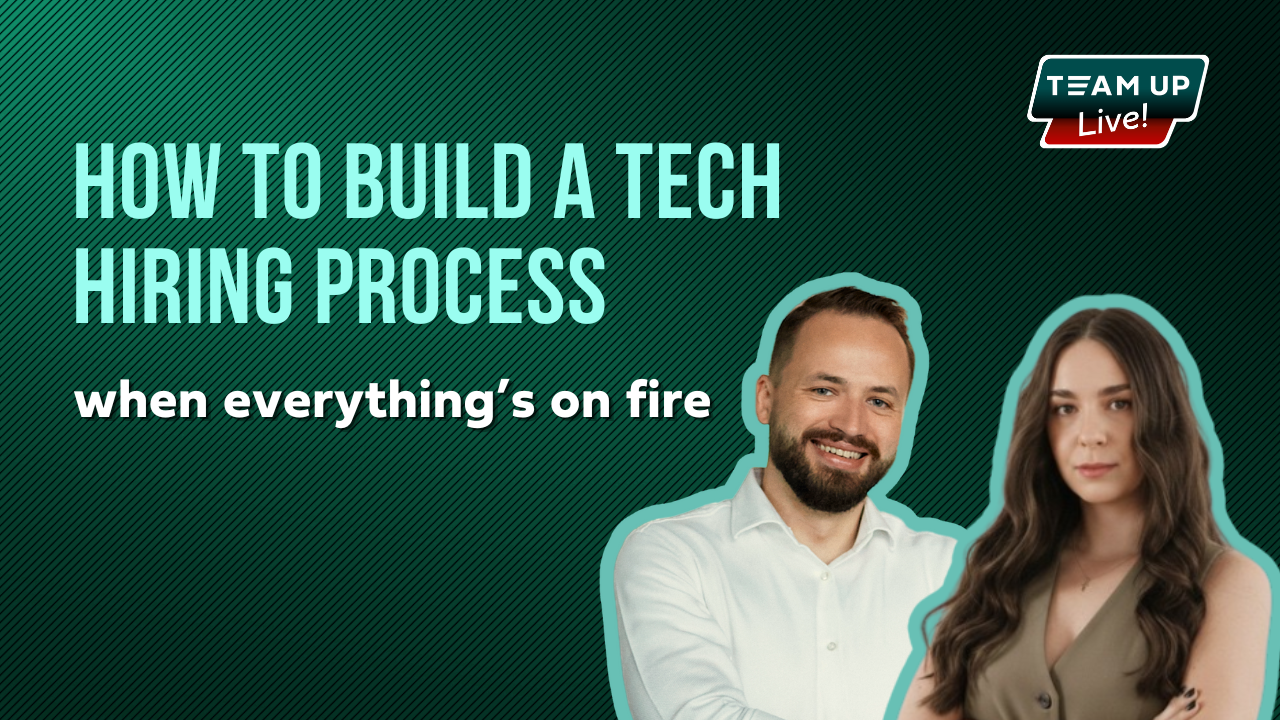
All these insights and practical takeaways were shared during Team Up Live! #10 “How to Build a Tech Hiring Process When Everything’s on Fire”, where Valeryia discussed her experience at Revolut and with early-stage startups.
We encourage you to watch the full conversation on YouTube.
The process doesn’t have to be perfect – it just needs to be consistent, transparent, and scalable. That’s what gives startups an edge: the ability to combine agility with maturity.
At Team Up, we’ve been helping startups and scale-ups make that shift for years – from firefighting to structured, effective hiring.
We build processes, support founders and leaders, and help them hire teams that truly deliver.
If your company is growing fast and you need support in creating a scalable recruitment process – let’s talk about how we can help.


 12 MIN


