


The question “why do you want to change jobs?” is asked by every recruiter – but few of us truly understand what lies behind a candidate’s answer. In a world where AI helps applicants prepare “perfect” responses and the IT job market is becoming increasingly competitive, the ability to uncover a candidate’s true motivation determines recruitment effectiveness more than ever before. Candidate motivation in IT recruitment is examined along two axes – push (what is driving them away from their current company) and pull (what is drawing them to a new role) – using behavioral questions instead of generalities. In this article, we show how the best technical recruiters do it – based on the practices of Magdalena Chruściel-Jedynak, Senior Technical Recruiter at Google with over 12 years of experience in technical recruitment in an international environment.
Article outline
1. What is candidate motivation and why is it worth examining?
2. Four motivation theories worth knowing as an IT recruiter
3. Push and pull – two axes of candidate motivation
4. Questions that reveal a candidate’s true motivation
5. How to record and use information about motivation?
6. Senior motivation vs. junior motivation in IT recruitment
7. Moments of truth – when it’s easy to lose a candidate’s motivation?
8. Overqualified candidate – how to navigate the motivation conversation?
9. AI and candidate authenticity – a new challenge for recruiters
What is candidate motivation and why is it worth examining?
Candidate motivation in IT recruitment is a set of factors that prompt a specialist to consider changing jobs and draw them toward a specific offer. In recruitment practice, it is divided into two axes: push motivation (what is driving the candidate away from their current company) and pull motivation (what is drawing them toward a new role).
Examining motivation is not a formality at the beginning of the process. As Magdalena Chruściel-Jedynak from Google emphasizes, asking about motivation is in fact a candidate pre-closing. You return to these notes at the end of the process to effectively close the recruitment and tailor the offer to what truly matters to the candidate.
If listeners are to take one sentence away from this webinar, I would say that asking about motivation is a kind of candidate pre-closing. We ask the candidate about their motivation at the beginning of the process – both push and pull – and at the end, in order to close that candidate, we need to return to our notes and see what the candidate came to us with.
– Magdalena Chruściel-Jedynak, Senior Technical Recruiter at Google
In companies that must actively compete for top talent with Big Tech, the ability to differentiate candidates at the motivation level is often what determines whether a process closes with an accepted offer – rather than a rejected one.
Four motivation theories worth knowing as an IT recruiter
An IT recruiter doesn’t need to be a psychologist, but knowing a few classic motivation models allows for more accurate interpretation of candidates’ responses and better tailoring of communication.
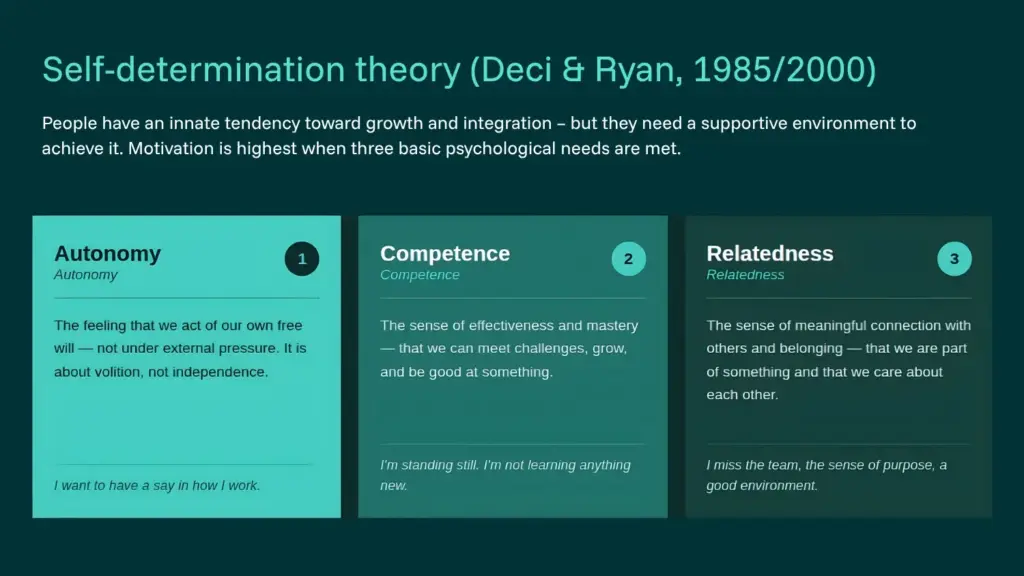
1. Self-determination theory (Deci & Ryan)
One of the most thoroughly researched and most frequently cited contemporary motivation theories: the Self-Determination Theory by Edward Deci and Richard Ryan, developed since the 1970s and supported by thousands of empirical studies across various cultures and professional contexts. Its fundamental thesis is seemingly simple, but has profound practical implications: engagement and long-term job satisfaction do not come from bonuses, benefits, or managerial pressure, but from the fulfillment of three fundamental psychological needs.
The first of these is autonomy – the sense that we are the authors of our own actions, that we have real influence over what we do, how we do it, and when. This is not about anarchy or a lack of structure, but about a person feeling like an agent rather than the executor of someone else’s script. When autonomy begins to diminish (because everything is micromanaged and every decision must pass through three levels of approval) intrinsic motivation fades even in people who previously loved their work.
The second need is competence – the conviction that we are good at something, that we are growing, that our efforts produce visible results. That is why tasks that are too easy become boring, while tasks that are too difficult become frustrating; true engagement is born in that narrow zone where the challenge slightly exceeds current skills but still remains within reach. Feedback, the opportunity to learn, and clear success criteria are key here.
The third is relatedness – the sense of meaningful connection with others, of belonging to a team or community where we are seen and valued as people, not as resources. And it is precisely this element that proves most fragile in hybrid and remote work models. Zoom meetings efficiently handle the exchange of information, but rarely create that informal, spontaneous closeness that arises by the coffee machine, in a passing hallway conversation, or over a shared lunch. Professional relationships then begin to resemble transactions: functional, but shallow. And employees, though they see each other on screen every day, report a growing sense of isolation. Building an authentic community in a distributed team therefore requires the deliberate design of opportunities for contact, rather than assuming it will “sort itself out.”
2. Daniel Pink’s model: Autonomy, mastery, purpose
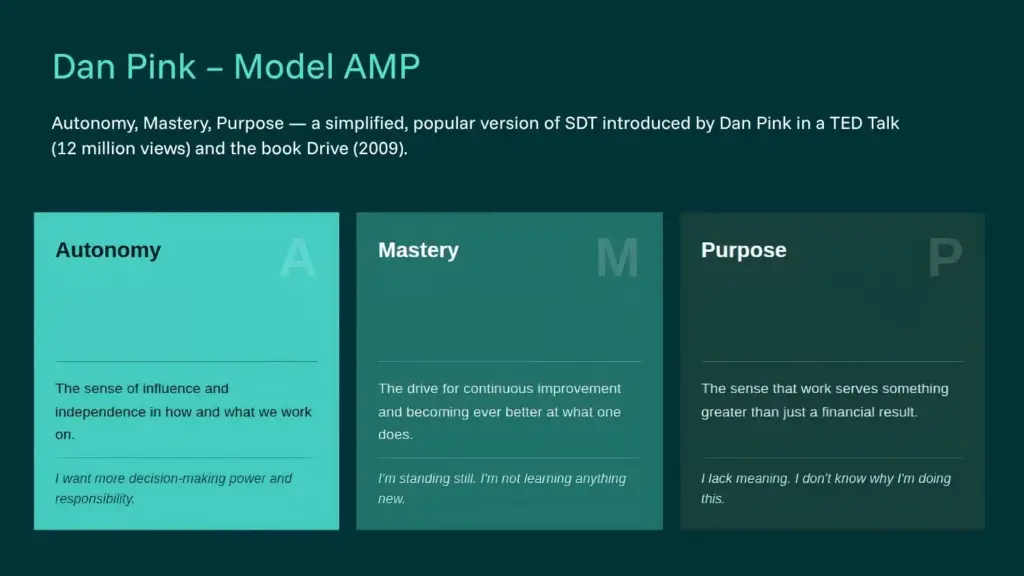
A more business-oriented and accessible take on the same phenomenon was proposed by Daniel Pink in his book Drive and in his famous TED talk, which has garnered tens of millions of views. Pink, analyzing decades of motivation research, concluded that the classic “carrot and stick” model – a system of punishments and financial rewards – works exclusively for simple, mechanical tasks. The moment work requires thinking, creativity, or solving complex problems, money ceases to function as the primary motivator and sometimes even reduces performance. So what does work?
According to Pink, true, lasting motivation is built on three pillars:
The first is autonomy, meaning the freedom to decide what we do, how, when, and with whom.
The second is mastery, understood as the deep need to become progressively better at something that matters to us. It is the same force that drives a musician to practice scales after hours, and a programmer to spend the weekend working through a problem no one is paying them for.
The third, perhaps the most powerful, is purpose, meaning the sense of meaning and belonging to something greater than ourselves.
It is precisely this third element that explains phenomena which, from a purely economic perspective, seem irrational. Why do people in well-paying corporate positions drop everything to start a foundation? Why do programmers devote dozens of hours a week to open source projects without earning a single penny? Why do doctors go on humanitarian missions to conflict zones, accepting conditions they wouldn’t even want to hear about back home? The answer is always the same: because they see deep meaning in it. When a person feels that their work is genuinely changing the world, even by a millimeter, reserves of energy and engagement are unlocked that no quarterly bonus is capable of producing.
3. Victor Vroom’s expectancy theory
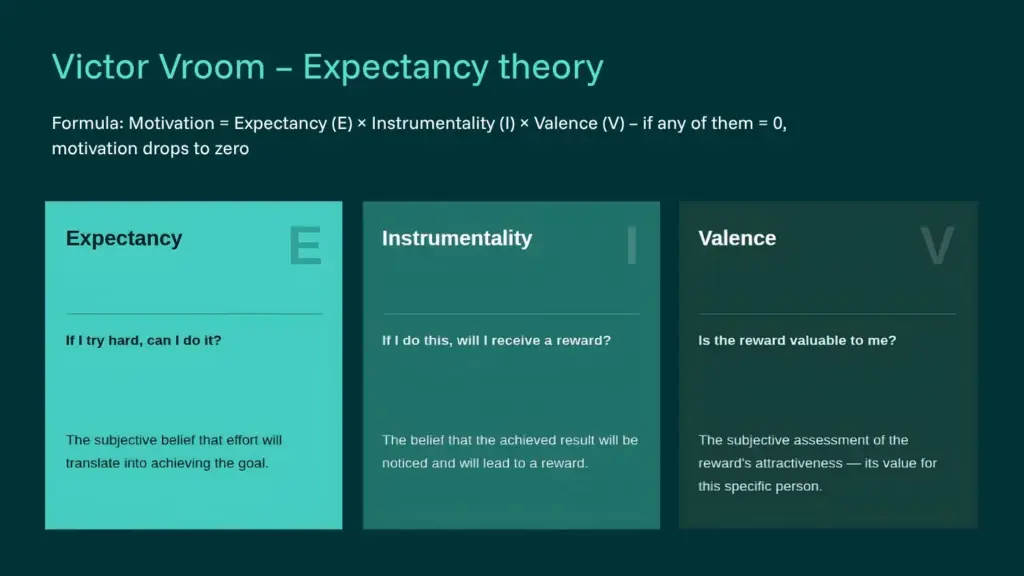
This theory was formulated in 1964 in the book Work and Motivation and shifts the discussion of motivation from the language of emotions and needs to the language of cold calculation. Vroom, a Canadian business psychologist associated with Yale, started from a simple but groundbreaking assumption: people do not act under the influence of abstract drives, but instead perform a very concrete analysis in their minds. Before committing to any action, they consciously or subconsciously ask themselves three questions, and the lack of a convincing answer to any one of them can stifle motivation at its root.
The first element is expectancy, meaning the belief that my effort will actually translate into results. In plain terms: “if I try hard, will I succeed?” If an employee does not believe they are capable of completing the assigned task – because they lack the competence, tools, time, or support – they will not make a genuine effort, regardless of how tempting the reward might be.
The second element is instrumentality, meaning the belief that the achieved result will actually be linked to the promised reward. In other words: “if I succeed, will I really get what I was promised?” In organizations where promotions are discretionary, bonuses are paid unpredictably, and praise goes to the wrong people, this element is the first to fail. People quickly learn that effort and results have no real bearing on what happens to them, and they stop trying.
The third element is valence, meaning the subjective attractiveness of the reward. Here Vroom did something that many managers continue to ignore to this day: he reminded us that a reward is only worth as much as it means to a specific person. For one employee, a promotion to a managerial position is a dream come true; for another, it is a nightmare filled with meetings and responsibility they never wanted. A financial bonus will delight someone repaying a loan, but leave indifferent someone who values an extra week of vacation more.
According to Vroom, motivation only arises when all three elements are high simultaneously. If even one of them is close to zero, the entire motivation drops to zero, regardless of how strong the other two may be.
In recruitment, this model works particularly well because the job application process is essentially a series of candidate decisions in which each of these three variables is being tested. At the expectancy level, the candidate assesses whether they have a chance at all: if the job posting is overloaded with requirements, the process appears multi-stage and unpredictable, and the communication is chaotic, many people give up before even clicking “apply.” At the instrumentality level, the question arises whether the effort put into interviews, recruitment tasks, and tests will truly end in a concrete offer, or whether it will be wasted in a process that ends without any feedback. Finally, at the valence level, the candidate weighs whether the final offer (salary, scope of responsibilities, company culture, development opportunities) is genuinely attractive to them at that specific moment in their life.
4. Herzberg’s two-factor theory
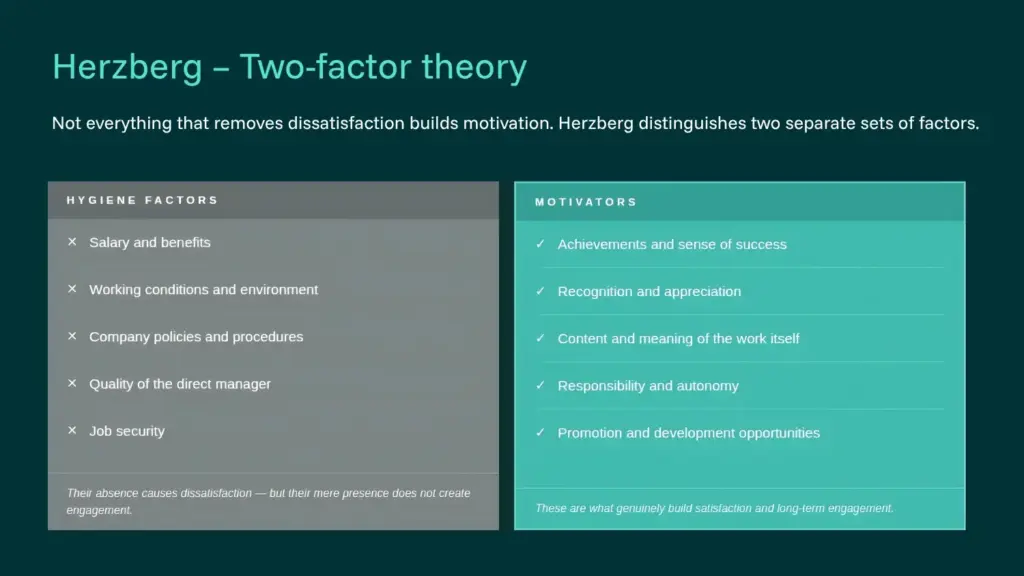
Frederick Herzberg’s two-factor theory, first published in 1959 in the book The Motivation to Work and based on a series of interviews with engineers and accountants from the Pittsburgh area, is one of those classics that, despite more than sixty years having passed, still accurately describes the mechanisms at work in today’s companies. Herzberg asked his subjects seemingly mundane questions: what makes you feel great at work, and what makes you feel terrible? When he began analyzing the responses, he noticed something that turned the prevailing thinking about motivation upside down. It turned out that job satisfaction and dissatisfaction are not two ends of the same scale. Removing what annoys us at work does not make us start loving it. It only makes us stop complaining. And those are two entirely different things, driven by entirely different factors.
On this basis, Herzberg distinguished two groups of factors that operate in entirely different ways:
The first group is hygiene factors, named by analogy to hygiene in medicine: an adequate level of it does not make you healthier, but its absence will quickly make you ill. These include salary, benefits, working conditions, company policies, job security, the relationship with one’s supervisor, and team atmosphere. When these elements fall short, real frustration emerges: the employee complains about their boss, talks negatively about the company during breaks, and starts looking for another job. However, when everything is at a decent level, it does not generate enthusiasm, only silence. Nobody walks around the office repeating that they are delighted by the modern coffee machine or the on-time salary payment. These things are simply expected to be in place, and their presence moves an employee from minus to zero, but not a single step further.
The second group is motivators, which work in exactly the opposite way. These include achievements, recognition for work well done, the content and interest of the tasks performed, a sense of responsibility, opportunities for growth and advancement, and a deeper sense of meaning. The absence of these elements usually does not cause rebellion or open frustration, but rather a slow fading away. Their presence, however, is the only thing that truly builds engagement, pride, and loyalty. It is precisely the motivators that make someone talk about their work with a sparkle in their eye, rather than simply replying “I can’t complain.”
For business practice, and especially for recruitment and team management, this leads to a conclusion that many managers receive with disbelief. A pay raise alone rarely solves an engagement problem. Sure, it may improve morale and silence complaints for a few weeks, but then the new salary level simply becomes the new normal and everything returns to square one. If the work is fundamentally boring, meaningless, and unappreciated, no pay raise will fix that. It will move the employee from minus to zero, but will not bring them even a millimeter closer to genuine satisfaction. That is why companies that compete for talent on salary alone lose to companies that can additionally offer meaningful work, real development opportunities, and recognition. Money opens doors, but what happens after crossing the threshold determines whether someone will stay for the long term.
Push and pull – two axes of candidate motivation
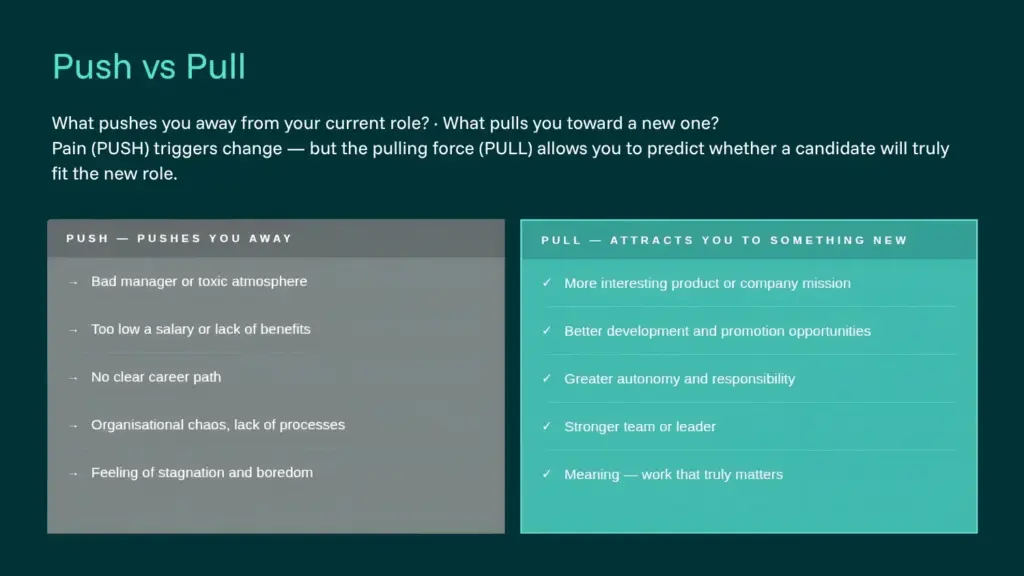
The most practical and most commonly used framework in a recruiter’s daily work is the simple yet highly effective distinction between two forces acting simultaneously: push and pull. The metaphor is physical and intuitive. The candidate is like an object on which two vectors act. One pushes them away from their current situation, the other draws them toward a new one. The decision to change jobs is made when the sum of these forces becomes large enough to overcome natural resistance – because changing jobs means stress, risk, and effort, and people naturally prefer the status quo.
Push motivation – what is driving the candidate away from their current workplace:
- insufficient salary
- lack of development opportunities
- conflicts within the team or with the manager
- organizational changes, risk of layoffs
- burnout, repetitiveness of projects
- misalignment of values with the company
Pull motivation – what is drawing the candidate toward a new role:
- employer brand
- interesting projects and technologies
- international environment
- product scale and impact
- mentoring and development opportunities
- flexible work model
Przygotował tłumaczenie tekstu o rekrutacjiIn recruitment practice, it is crucial to understand that push force alone is rarely sufficient for a successful recruitment, even if the candidate says they “have to get out of here.” Candidates driven solely by the need to escape often make hasty decisions that, shortly after being hired, end in disappointment and a quick departure – because it turns out the new place simply has a different set of flaws. On the other hand, pull force alone, without a clear push, usually does not cross the threshold of action, because a candidate who is genuinely happy in their current job rarely decides to risk a change just because the grass is greener elsewhere. The most mature decisions are made when both vectors are clear and consistent: the candidate knows what they are running away from, and equally knows why they are heading to a specific place.
For a recruiter, two practical conclusions follow from this. First, the first conversation with a candidate is not an examination of competencies, but a mapping of both vectors. Questions such as “what is making you consider a change today?” and “what would need to be present in a new role for it to be valuable to you?” can tell you more in fifteen minutes than an hour-long conversation about experience. Second, it is worth consciously building the offer and communication with the candidate so that it responds to both what they are running away from and what they aspire to. A candidate who hears “with us, you won’t be stuck on the same project for three years, and you’ll be working on X within a team that does Y” receives both a remedy for their push and a genuine pull at the same time. And that is precisely when the decision comes naturally.
Why is push motivation particularly important when there is a risk of a counteroffer?
As Magda Chruściel-Jedynak points out, in companies with a strong brand, pull-type responses tend to be predictable – most candidates indicate similar factors. It is precisely push motivation that allows recruiters to differentiate candidates from one another and predict the risk of a counteroffer.
The question What motivates you? is not enough for me to differentiate candidates from one another, because most people are motivated by the same things. For me, the push-pull model is an additional thing that I note down by asking the question: what would make you leave your company? Because if I give a candidate an offer, but their current company makes a counteroffer – why should they accept ours?
– Magdalena Chruściel-Jedynak, Senior Technical Recruiter at Google
If a candidate has strong pull factors but few push factors, the risk of accepting a counteroffer and staying at their current company is significantly higher. That is why it is worth having a transparent conversation with the candidate about counteroffers – informing them that this is a well-known market practice and that they may encounter it.
For many candidates, a counteroffer is a signal that they have been “appreciated.” The recruiter’s role is to ground this perception in reality – to show that a counteroffer is a standard retention tactic, not a genuine resolution of the factors that prompted the candidate to look for a new job.
Questions that reveal a candidate’s true motivation
Every experienced recruiter knows that moment. You ask a candidate what motivates them, and the response is a set of worn-out phrases: “I’m looking for new development opportunities,” “I want to work in an ambitious team,” “I care about interesting projects.” After such a conversation, you know exactly as much about the candidate as you did before – which is nothing. These answers are not dishonest, they are simply worthless, because they fit every person and every situation. Good motivation questions share one common quality that generalities lack: they force specificity and prioritization. They do not allow hiding behind abstraction, because every good answer requires drawing on a real experience or making a difficult decision in front of the recruiter.
Behavioral questions instead of generalities
That is why instead of asking “what motivates you?”, Magda Chruściel-Jedynak uses questions that force the candidate to draw on real experiences:
- “Describe a day at work after which you came home feeling immense satisfaction. What exactly was happening then?” – the question looks for specifics, not declarations. Candidates, even the more introverted ones, are usually very eager to talk about what they enjoy at work.
- “If you had two financially identical offers, what would determine your choice between them?” – the question forces a prioritization of values and reveals what is genuinely at the top of the candidate’s needs.
- “What would need to change for you to consider staying at your current company?” – a question that verifies the strength of push motivation.
- “Which projects / technologies / tasks fascinate you the most right now?” – particularly effective in conversations with engineers, who quickly open up when it comes to technical topics.
Three decision-making factors
- in the majority of cases, development appears in first place (understood broadly: as the opportunity to learn, advance, gain exposure to interesting problems, and work alongside people more experienced than oneself),
- salary most often appears in second or third place (money is important, but it is rarely the sole or primary reason for changing jobs),
- in recent years, the work model (remote or hybrid) has emerged as a separate, hard decision-making factor. It is worth knowing that for some candidates, the lack of a remote work option automatically disqualifies an employer from consideration, regardless of how attractive the rest of the offer may be.
Interestingly, this list of three priorities can save recruitments that look like lost causes on paper, and sink those that seemed like sure things. A candidate who places development above salary will go to a company offering less money if they receive access to more interesting problems and a stronger team in return. And conversely, even the most attractive offer can fall apart over one unmet condition from the top three, because in the candidate’s mind a simple logic applies: if the company does not give me what matters most to me, the rest stops counting.
FUN FACT:
It is worth remembering that the “development, salary, work model” pattern is an averaged picture that best fits the dominant group of candidates applying for specialist positions today – those currently aged 28–45. In other generations, the arrangement shifts. Among Generation Z, work-life balance, mental health, and company values rank very highly, sometimes higher than development, and remote work is treated as a default assumption rather than a perk. Among Generation X and experienced experts, on the other hand, stability, impact, decision-making authority, and respect for prior experience take center stage, while development in the classically understood sense fades into the background.
Interestingly, academic research – for example, David Costanza’s meta-analyses – shows that generational differences are in reality much smaller than the media suggest, and that life stage plays a greater role than generation itself. A thirty-year-old with a young child and a fifty-year-old whose children have just become independent may have entirely different priorities, even though they work in the same industry. That is why it is always worth asking about decision-making factors directly.
Questions about life context and other processes
Two seemingly technical questions that are in reality crucial for conducting the process sensibly are: “are you actively looking for a job right now?Two seemingly technical questions that are in reality crucial for conducting the process sensibly are: “are you actively looking for a job right now?” and “are you involved in any other recruitment processes?” The answer to these changes everything, because it determines the pace at which the recruiter should act.
15:00Claude responded: A candidate who is in the advanced stages of three other processes and expects offers within two weeks requires entirely different treatment than a passive can…A candidate who is in the advanced stages of three other processes and expects offers within two weeks requires entirely different treatment than a passive candidate who is just beginning to look around. In the first case, every day of delay is a real risk of losing the candidate to the competition. In the second case, excessive urgency can actually put off someone who needs time to think things through and compare options. Without this knowledge, the recruiter is operating in the dark.
It is worth showing empathy in these conversations and going beyond the timing alone. The candidate’s professional situation – for example, circulating rumors about a restructuring, the risk of layoffs, a change of manager, or a team reorganization – often shapes their motivation more powerfully than all rational arguments combined. A candidate who learned two weeks ago about the planned closure of their department thinks about work in an entirely different way than someone calmly considering their next career step. A recruiter who understands this and is able to ask a few additional, friendly questions about the broader context gains not only a fuller picture of the situation, but also the candidate’s trust. And trust in recruitment is a currency that cannot be bought with any benefit.
How to record and use information about motivation?
A good recruiter does not rely on memory. Notes about a candidate’s motivation are not a bureaucratic requirement, but a real working tool that is returned to multiple times throughout a weeks-long process: before each subsequent conversation, when writing a recommendation for the hiring manager, when negotiating an offer, and sometimes even months after hiring, when it becomes necessary to understand why a newly hired employee is beginning to show signs of dissatisfaction.
Minimal template for a screening call note on motivation:
- location and preferred work model, as this is one of the hard decision-making filters that can derail the process at the last minute if not established at the outset,
- professional situation, meaning information about whether the candidate is actively looking for a job or is passive, and if actively looking, whether they are involved in other advanced processes,
- financial expectations, recorded specifically (gross or net range, fixed plus variable, any equity value), not in general terms,
- push motivation, meaning what is driving the candidate away from their current company, recorded with as much specificity as possible (not “lack of development,” but “the same scope of tasks for a year and a half, no clear path to a senior engineer promotion”),
- pull motivation, meaning what is drawing them toward a new role, also recorded in the candidate’s own words rather than in the recruiter’s paraphrase,
- a description of “a good day at work”, ideally quoted in fragments, because that is where the strongest signals about genuine motivators are hidden,
- three decision-making factors indicated by the candidate in order of importance, with a brief comment on what exactly they mean in their understanding,
- risk factors, meaning everything that could complicate or block the process: the need to relocate, a change of technology stack, visa matters, notice period, waiting for a quarterly bonus, parallel conversations with another employer.
Notes made in this way become an invaluable tool not only for the recruiter themselves, but also – and perhaps above all – in conversations with the hiring manager. In many companies, particularly in Big Tech and mature technology organizations, closing a candidate is a shared responsibility: the final closing conversation is often conducted not by the recruiter, but by the hiring manager themselves. If such a manager receives a reliable motivation map note in advance, their conversation is by design aimed at what truly matters to the candidate. Instead of reciting a general company presentation, the manager can consciously address specific needs: talk about real development paths, show examples of interesting projects, present the team structure, or explain how flexibility works in practice.
Equally important is the fact that good notes allow the manager to honestly flag reservations – meaning those elements that the company is unable to fulfill. If a candidate expects fully remote work and the company has recently introduced a requirement of three days in the office, it is better to say so directly at the closing stage than to pretend the problem does not exist and run into it during offer negotiations, or worse, two months after hiring. Transparency at this point builds trust and saves everyone – including the candidate themselves – from painful disappointments. And no transparency can be achieved without a reliable note that captures what was said before human memory has a chance to distort it.
It is always worth recording all information in your notes and returning to them when making an offer. That is why, when presenting an offer, I can say to the candidate: Listen, you told me this was important to you, which is why I have prepared a relocation package for you. Because you are relocating from another country, the financial and housing aspect was important to you, so we created a package tailored to your needs.
– Magdalena Chruściel-Jedynak, Senior Technical Recruiter at Google
Senior motivation vs. junior motivation in IT recruitment
Motivators change with the candidate’s level of experience. What works for a junior can actually be demotivating for a senior.
Senior motivation in IT recruitment
For a senior (meaning, broadly speaking, someone with ten or more years of experience) technology itself ceases to be the primary motivator. Over the course of their career, such a candidate has already worked across several stacks, witnessed the rise and fall of trendy frameworks, and regards learning a new language as a matter of months rather than an exciting professional challenge. A recruiter who tries to win over a senior with the promise of “working with modern technologies” most often misses the mark, or even comes across as patronizing, because the candidate hears a hidden message: “we treat you as someone who is still learning.” The true motivators for this group lie at much higher levels of the needs hierarchy:
- project scale and variety – the opportunity to work on different problems, to move between teams within a large organization
- mentoring – guiding other team members, passing on knowledge
- impact and cross-functionality – working with other teams, including often with teams in the US (with a caveat: it is worth asking whether the candidate sees this as an opportunity or as a threat to working hours beyond the standard)
- implementing new technologies, particularly today – AI as the main topic of conversations with seniors
- a career path extending beyond the software engineer role – how to develop further without going into classic people management
The common denominator of all these elements is the need for real impact and meaning, rather than yet another technical challenge. A senior who, after a decade of work, is still sitting over their own code alone begins looking for something more, because they feel that their experience could bring greater value if only the company gives them the space for it. That is why in conversations with experienced candidates, it is not the organizations with the newest stack that win, but those that can tell a credible story about how specifically the senior will be able to grow, make an impact, and leave something lasting behind.
Junior motivation
For juniors, priorities are fundamentally different because the career stage is different. Someone who is just starting out professionally does not yet think in terms of “strategic impact” or “long-term expert track.” For a junior, more tangible and near-term things matter.
Juniors ask about specific promotion timelines, seniority levels within the company, and a clear financial outlook far more often than seniors do. They want to know how soon they can realistically expect to move from junior to mid-level, exactly what needs to happen in that time, what the evaluation process looks like, and what salary ranges are associated with each successive level. This is not impatience or a lack of perspective – it is a healthy need for orientation in a world they do not yet know. A junior who cannot see a path for the next two or three years quickly starts looking around, because the market at entry levels moves much faster than at the senior level.
Here an important rule applies: never promise what you are not responsible for.
One must be careful with declarations. If a candidate asks how many years it will take to get a promotion – I do not give a specific answer. Because if they get the job and then come back with an email saying: Magda promised me that in three years I would get a promotion and a raise. Where is that raise? That is why it is best not to make that kind of declaration.
– Magdalena Chruściel-Jedynak, Senior Technical Recruiter at Google
15:21Claude responded: It is tempting, in response to the question “how many years until I get a promotion?It is tempting, in response to the question “how many years until I get a promotion?”, to give a specific number, because the candidate clearly expects it, and a concrete answer looks professional and helps close the process. The problem is that the candidate will remember that answer word for word, while the recruiter most often will not. At that point it no longer matters whether such a promise was actually made or whether the candidate simply interpreted the recruiter’s general remark in their own way. Trust has been broken, and the blame falls on whoever made the declaration.
That is why instead of throwing out specific timelines, it is worth talking about mechanisms. Describe how the evaluation process works at the company, what typically determines the pace of promotion, what the usual development paths look like for people at a given level, and what the company expects from a candidate at each successive stage. The candidate receives something more valuable than a promise: a realistic picture of what their development actually depends on. And the recruiter, instead of issuing a promissory note they cannot cover, builds a relationship based on honesty.
Motivation of relocating candidates
A separate category deserving attention is one that has gained importance in recent years, especially in the technology industry and in companies with a global reach. This refers to candidates relocating from another country, most often from outside the European Union, who require sponsorship of a work visa. Recruiting such individuals follows its own rules and carries a different risk profile than a classic local process. The mere fact that a candidate is willing to accept an offer does not yet mean the company has made a good decision, because the road from a signed contract to an actual start date can be long, costly, and full of surprises.
Financial motivation alone in these processes is decidedly insufficient, and can even be a warning signal. The visa process can take months, sometimes over a year, and involves many people on the company’s side: the HR department, an immigration law firm, the mobility team, the manager, and the recruiter. It generates real costs (government fees, lawyers’ fees, a relocation package covering the move, initial accommodation, and sometimes costs for the candidate’s family as well) that can reach tens of thousands of euros. If the only magnet that attracted the candidate is money, there is a significant risk that after six months, once they have settled in and sorted out the formalities, they will simply leave for a competitor offering slightly more. The company is then left with invested time, sunk costs, and an empty spot in the team, while the entire recruitment cycle has to start from scratch.
That is why in conversations with relocating candidates it is worth asking more probing questions than in standard processes, and consciously looking for motivation that goes beyond salary. What interests us are reasons that are harder for the next employer to outbid: the desire to gain experience in a specific ecosystem, or the prospect of joining a recognizable brand that the candidate has admired for years.
One of the most useful tools in such conversations is a simple but revealing question: “if we were unable to pay as much as you expect, only X, would you still accept the offer?” The answer can resolve the process faster than several more conversations. If the candidate, after brief reflection, answers affirmatively and can explain why this specific role matters to them despite the lower rate, the recruiter receives a signal that something more than salary is at play and the investment has a chance of paying off. If, on the other hand, the answer is an unequivocal “no,” and the candidate’s entire argument from the beginning of the conversation boils down to a number on a pay slip, it is worth honestly considering whether to continue this process at all. Relocation based solely on money is like a relationship based solely on tax benefits. It may work for a while, but rarely survives the first moment someone else offers slightly better terms.
Moments of truth – when it’s easy to lose a candidate’s motivation?
A candidate’s motivation is not a fixed state that can be measured once during screening and considered settled for the entire process. In reality, it is a variable that rises and falls day by day, and sometimes hour by hour, in rhythm with every interaction with the company. A well-run process can awaken genuine enthusiasm in a candidate, even if they were only moderately interested in the offer at the beginning. A poorly run process, on the other hand, can cool even the most motivated candidate and lead them to withdraw just before signing the offer. It is crucial to understand that the recruiter and hiring manager are not passive observers of this process, but active participants who shape its outcome with every email, every conversation, and every minute of silence.
Magda Chruściel-Jedynak identifies two most critical moments at which a candidate’s motivation most easily breaks down. Both are mundane, both seem manageable, and both regularly kill promising recruitment processes.
1. Silence after the interview and lack of substantive feedback
We promised to get back within three days, and we come back after three weeks. The candidate devoted several hours, and sometimes an entire weekend, to a recruitment task, went through two technical interviews, rearranged their calendar to make room for further conversations, and in return receives a generic message automatically generated by an ATS system, or worse, nothing at all. Every day of that silence is a message, even if the company did not intend to send one.
For a candidate who today has a stable job and does not need to change it, this silence is an informational signal about the company – and a very powerful one. They then ask themselves a simple question: if this is what communication looks like at the stage when the company wants to hire me and should be showing its best version of itself, what will everyday life look like once I commit? The answer that comes to mind is rarely optimistic. And it is often precisely at this moment – not during offer negotiations – that the decision to stay with their current employer is made.
2. Discrepancy in role description between the recruiter and the hiring manager
The second classic motivation breakdown scenario is the moment when the candidate realizes that two people from the same company are telling them two different stories about the same role. The recruiter described project A, a modern stack, and an international team. The hiring manager in the next conversation talks about maintaining project B, an older technology, and a local team. The candidate begins mentally piecing this information together and arrives at a simple conclusion: either one of these people does not know what they are talking about, or someone here is not being entirely honest.
In both cases the reaction is the same: a sharp drop in trust. The candidate stops believing they know what they are actually applying for, and uncertainty is one of the most effective fuels for the decision to withdraw from the process. This is particularly damaging for passive candidates, who were already entering the recruitment with some reluctance. Every discrepancy gives them an internal justification to return to the comfort of their current job.
It is worth noting here that in large organizations such as Big Tech, recruitment often takes place not for one strictly defined role, but for the company and a competency domain, with the specific team being matched only at the final stage of the process. This is a normal and sensible model, because it gives the company flexibility and the candidate greater chances of finding a good fit. However, it requires transparent communication from the very beginning. A message along the lines of: “the role you are applying for may no longer be open by the time the process concludes, but there will be others that are similar, and at the final stage you will meet with a specific hiring manager and will be able to ask all your questions about the team” – works as an honest forewarning rather than a later surprise. The candidate knows what to expect, and if they agree to it, they do not feel deceived when the team turns out to be different from what the job posting originally suggested.
Process length and engagement
Here we arrive at the tension that accompanies every recruitment process. From the candidate’s perspective, a shorter process is almost always better. Every additional week brings additional risk that a better offer will appear, life circumstances will change, initial enthusiasm will fade, or the current employer will notice that the employee is looking around. From the company’s perspective, however, thorough competency verification is crucial, because a bad hire costs significantly more than a few extra conversations. A single bad hire can absorb many months of salary, training costs, lost team productivity, and a manager’s time spent managing the problem.
For many technology companies, a realistic target is a time-to-hire of four to six weeks, although for seniors and specialist positions this time often stretches to eight weeks, and in some processes even longer. These are numbers worth keeping in the back of one’s mind as a reference point.
What is crucial is not the minimum time itself, but whether the process builds the candidate’s engagement or weakens it. A valuable eight weeks, during which the candidate progressively better understands the company and its product, receives reliable feedback after each stage, meets future colleagues, has the opportunity to ask questions, and gets to see the organizational culture in action, is decidedly better than a chaotic three weeks during which no one really talks to them, everything happens in a rush, and the decision is made somewhere in the background without their involvement.
In other words, process length is only a proxy indicator. What truly determines the outcome is the density and quality of contact with the candidate at every stage. A company that treats the recruitment process as an opportunity to build a relationship, rather than a formality to be ticked off, wins even when its process takes longer than the competition’s. Because a candidate who completes such a process does not only accept the offer, but does so with the feeling that they chose the company consciously, rather than out of resignation.
Overqualified candidate – how to navigate the motivation conversation?
One of the most difficult recruitment situations is a candidate who “looks too experienced” for the role they are applying for. The recruiter’s and hiring manager’s first instinct is often concern: is he just using us as a stopgap?
Magda Chruściel-Jedynak emphasizes: the key is to move from the level of assumptions to the level of evidence. Instead of assuming that a senior with 15 years of experience will not find their place in a specialist role, it is worth asking the question: “why now?”
The answers can be surprising. Some candidates, after several years in an engineering manager role, describe the experience as something that slowly drained their energy: meetings, budgets, conflicts, performance reviews. At some point they realize that managing people is not what drives them to work, and they want to return to coding. This motivation can be stronger and far more conscious than that of a junior looking for their first job, because it is backed by several years of testing the alternative. Other times, a person coming from a VP role in a startup returns to Big Tech as a senior, because they want to build a product that already has millions of users, and consciously trades a step down in title for access to the scale that the startup was unable to offer them.
A candidate whom our first instinct would be to screen out may turn out to be one of the most valuable in the entire process. They only require what every good motivational interview requires: a conversation instead of assumptions.
Questions for the overqualified candidate
A conversation with such a candidate is worth conducting directly, without beating around the bush. The goal is not to put them on the defensive, but to give them space to explain a decision that on paper may look illogical. The following questions help distinguish a candidate who genuinely wants this role from someone who is treating it as a temporary measure:
- “You have extensive experience in large corporations, and we are a dynamic scale-up. What makes this change of environment attractive to you?”
- “Why now, after so many years in role X, are you returning to role Y?”
- “Are you aware of what you are giving up by accepting this role?”
If the candidate is able to specifically name what they are giving up and still has compelling reasons for wanting this particular role – the risk of them treating the company as a stopgap noticeably decreases. Of course, it will not disappear entirely – no recruitment process provides a 100% retention guarantee.
AI and candidate authenticity – a new challenge for recruiters
The year 2026 has brought recruiters a challenge that practically did not exist three years ago. Candidates increasingly prepare for interviews with the help of AI tools: they paste in a job posting, describe their experience, and ask for a set of ideal answers to typical recruitment questions. The effect is easily recognizable to a seasoned recruiter: the first answers sound disproportionately polished, are well-structured, hit every keyword from the role description, and have none of the rough edges that normally appear in an authentic conversation.
How to reach a candidate’s authentic motivation in the AI era?
The answer is not to abandon questions about motivation, but to change the way they are asked. AI handles hypothetical and general questions very well, but struggles significantly with questions that require reconstructing a specific, personal experience in all its messy complexity. That is why it is worth applying a few simple principles:
- Ask behavioral questions, not hypothetical ones. “Describe a specific situation in which…” is harder to prepare for with AI than “what would you do if…”
- Dig for specifics. After a rehearsed answer, ask for details: what technologies exactly, what specific decisions were made, what were the consequences.
- Ask about moments of failure. The question “tell me about a situation when you accepted an offer that looked great on paper but turned out to be a disappointment – what did you miss?” is difficult to “generate.”
- Observe consistency. If the first answers are disproportionately polished compared to the rest of the conversation – that is a signal that it is worth deepening the discussion.
It is worth maintaining a healthy sense of proportion in all of this. Using AI to prepare for a recruitment interview is not dishonesty. A candidate who has thought through their motivations before the meeting and practiced articulating them is an engaged candidate, not a fraud. The recruiter’s task is not to catch someone using a tool, but to reach the real person standing behind that tool.
GOOD PRACTICE:
AI can also be a recruiter’s ally – Magda uses tools such as Gemini on a daily basis, including for generating constructive feedback for candidates. Based on the feedback provided by the interviewer, AI prepares a set of development recommendations that the recruiter can pass on to the candidate. Of course, without revealing specific statements from the interviews (which is also relevant from a GDPR perspective).
Summary: motivation as the foundation of effective IT recruitment
Examining candidate motivation in IT recruitment is not an additional step in the process, not a soft element that can be skipped when time is short, and not a decorative part of the screening conversation asked out of courtesy. It is the foundation that determines whether an offer will be accepted, whether the candidate will stay at the company for more than a year, and whether there is any clarity at all about who one is speaking to during the process.
Key takeaways from the practices of top tech companies:
- motivation is pre-closing – you start examining it in the first conversation, but actually use it when making the offer,
- push and pull are two different axes – both are important, but it is push that allows you to differentiate candidates from one another and predict the risk of a counteroffer,
- behavioral questions reveal more than direct questions – “describe a day after which you came home feeling satisfied” works better than “what motivates you,”
- do not promise, do not declare, do not exaggerate – especially regarding promotions and career development,
- transparency and authenticity are more important today than ever – including in an era when AI helps candidates answer recruitment questions “perfectly,”
- silence after the interview and a discrepancy between the recruiter and the hiring manager are the two biggest killers of candidate motivation during the process.
Technology recruitment is ceasing to be a game of knowing the stack – it is becoming increasingly a conversation about meaning, impact, and cultural fit. Recruiters who are able to conduct this conversation consciously and methodically are winning today’s battle for the best IT specialists.
If you would like to listen to the full conversation with Magdalena Chruściel-Jedynak and discover more practical tips – specific questions, recruitment stories from London and Google, as well as a rapid-fire section about the recruiter’s work – we invite you to watch episode 14 of Team Up Live on our YouTube channel and Spotify.
Are you recruiting for technology teams and want to win the battle for the best candidates? Let’s talk.


 12 MIN


