



Competition for top IT professionals is growing, and the recruitment process itself is becoming increasingly demanding which is why many companies choose to partner with an IT recruitment agency. The article compares three key collaboration models: Success Fee (pay only for results, ideal for individual, hard-to-fill vacancies), RPO (a dedicated recruiter working exclusively for your company, proven for intensive team scaling), and Contracting (fast access to specialists for project-based work, without creating permanent positions). For each model, we cover the advantages, drawbacks, billing structure, and real-world examples – from financial institutions looking for developers, through Scandinavian companies entering the Polish market, to American firms hiring IT teams in Poland without setting up a local entity.
In this article, you’ll learn:
1. Why is it worth working with an IT recruitment agency?
2. Success Fee model – what is it and when does it pay off?
3. What is RPO (Recruitment Process Outsourcing) all about?
4. Contracting (Body Leasing) – how does flexible IT outsourcing work?
5. Which collaboration model with a recruitment agency should you choose?
6. How to choose the best IT recruitment agency?
Competing for top IT talent
Effectively running a recruitment process is now one of the key elements in building a competitive edge in the IT industry. HR teams need to react quickly to business needs while also meeting the expectations of IT specialists and Hiring Managers. The competition for top candidates is growing, and recruiting IT professionals is becoming increasingly demanding.
That’s why many companies choose to partner with an IT recruitment agency. This approach not only shortens the time-to-hire but also offers the benefit of industry expertise, proven processes, and access to a broad talent pool. Depending on your company’s needs, IT recruitment agencies offer various cooperation models – from Success Fee, through RPO, to Contracting.
But which one is the best fit for your organization? What are the advantages of working with an IT recruitment agency, and how does the recruitment process look when they’re involved? Let’s explore the available options and find out how to choose the right service – tailored to your needs and the specific nature of your IT projects.
Success Fee – the most common partnership model
In the Success Fee model, an IT recruitment agency charges a fee only after the recruitment process is successfully completed – that is, once the candidate is hired by the client. Typically, the fee is a fixed percentage of the candidate’s annual salary. This approach minimizes financial risk for the employer and motivates the agency to present well-matched candidates as quickly as possible.
In theory, this model encourages commitment and efficiency. In practice, however, the key factor is how the agency operates. A professional and effective tech recruitment agency doesn’t just rely on an extensive contact base – it also follows clear processes, uses sourcing tools, and takes the time to understand the client’s needs.
It’s worth paying attention to whether projects are handled by experienced teams or individual recruiters, what the communication with the client looks like, and how many roles a given recruiter is managing at the same time.
All these factors have a direct impact on the quality of cooperation and the final outcome of the recruitment process.
Advantages of the success fee model
1. No financial risk at the start of cooperation with a recruitment agency
In the Success Fee model, a company only pays if the agency achieves the goal – that is, successfully hires a candidate. There are no upfront costs, no “paying for a try.” This allows you to bring in an external recruitment agency without needing to commit budget in advance – which is especially important for companies with flexible or limited resources. You minimize financial risk while increasing your chances of finding the right IT specialist.
2. Access to candidate databases and extensive professional networks
A well-run IT recruitment agency builds its talent pool over years – through recruitment processes, referrals, sourcing activities, and networking. As a result, they can reach not only active job seekers, but also passive candidates – those not applying to job ads but open to new opportunities. For the client, this means not just a wider selection, but a chance to reach top IT talent before competitors do.
3. Additional services such as market insights and industry reports
Working with a tech recruitment agency often means more than just “CV delivery.” Clients can gain access to valuable insights like salary trends, talent availability data, job offer benchmarks, and expert advice on employment models or employer branding. A reliable agency also supports offer management and negotiations, sharing knowledge and experience from dozens of past projects – significantly improving your chances of hiring success.
Disadvantages of the Success Fee model
1. Hidden internal costs linked to team involvement
While the Success Fee model carries no initial financial commitment, that doesn’t mean the process is entirely cost-free. Even if no hire is made, your internal team – recruiters, hiring managers, HR, or tech leads – invest time in reviewing CVs, conducting interviews, giving feedback, and coordinating steps. If the agency is ineffective or the process drags on, this involvement can become a significant, unrewarded cost. It’s important to factor this in when evaluating the real cost of “unsuccessful” cooperation.
2. Risk of low service quality if you choose the wrong partner
Not all IT recruitment agencies follow structured processes or have experienced, specialized teams. In the Success Fee model, some agencies may focus on volume over quality, sending unverified CVs or trying to “win” with speed rather than fit. A lack of results, poor candidate matches, or communication issues are red flags suggesting the collaboration may not deliver. That’s why verifying your recruitment partner beforehand is essential – their approach, experience, and team capabilities directly impact the final outcome.
Who is it for?
The Success Fee model is a great fit for companies that hire IT specialists regularly or occasionally, but prefer to pay only for results rather than upfront fees. It’s especially useful for hard-to-fill roles, such as those requiring niche technologies, rare skill combinations, or senior-level expertise.
It’s also a smart solution for organizations without large in-house recruitment teams or those facing a temporary hiring peak – a sudden spike in demand for new employees. This model lets you boost recruitment capacity quickly without building internal resources long-term.
Startups and scale-ups often benefit from this model as well. It allows them to move fast and stay flexible with budgets while still securing top-tier IT specialists needed to grow the product or deliver investor-critical projects.
Example: how success fee works in practice
A global financial institution, despite having a well-established internal recruitment team, faced a challenge: they had to hire a dozen developers in a popular tech stack within a tight deadline. The internal team was already stretched, and the timeline was non-negotiable.
To speed up the process without adding permanent costs, the company turned to an external agency under the Success Fee model. This solution not only eliminated financial risk but also gave them immediate access to vetted candidates. As a result, they filled both the urgent roles and several niche positions that the internal team had struggled with for months.
How is it billed?
The most common billing method in the Success Fee model is a percentage of the hired candidate’s annual salary.
In some cases, companies agree on a fixed amount for each successful hire – known as a Flat Fee.
An alternative is the Retainer model, where part of the fee is paid at the start of the cooperation, regardless of the final result. Hybrid models are also common – for example, partial upfront payment for team engagement, with the rest tied to hiring a matched candidate.

RPO (Recruitment Process Outsourcing) – a dedicated recruiter working exclusively for you
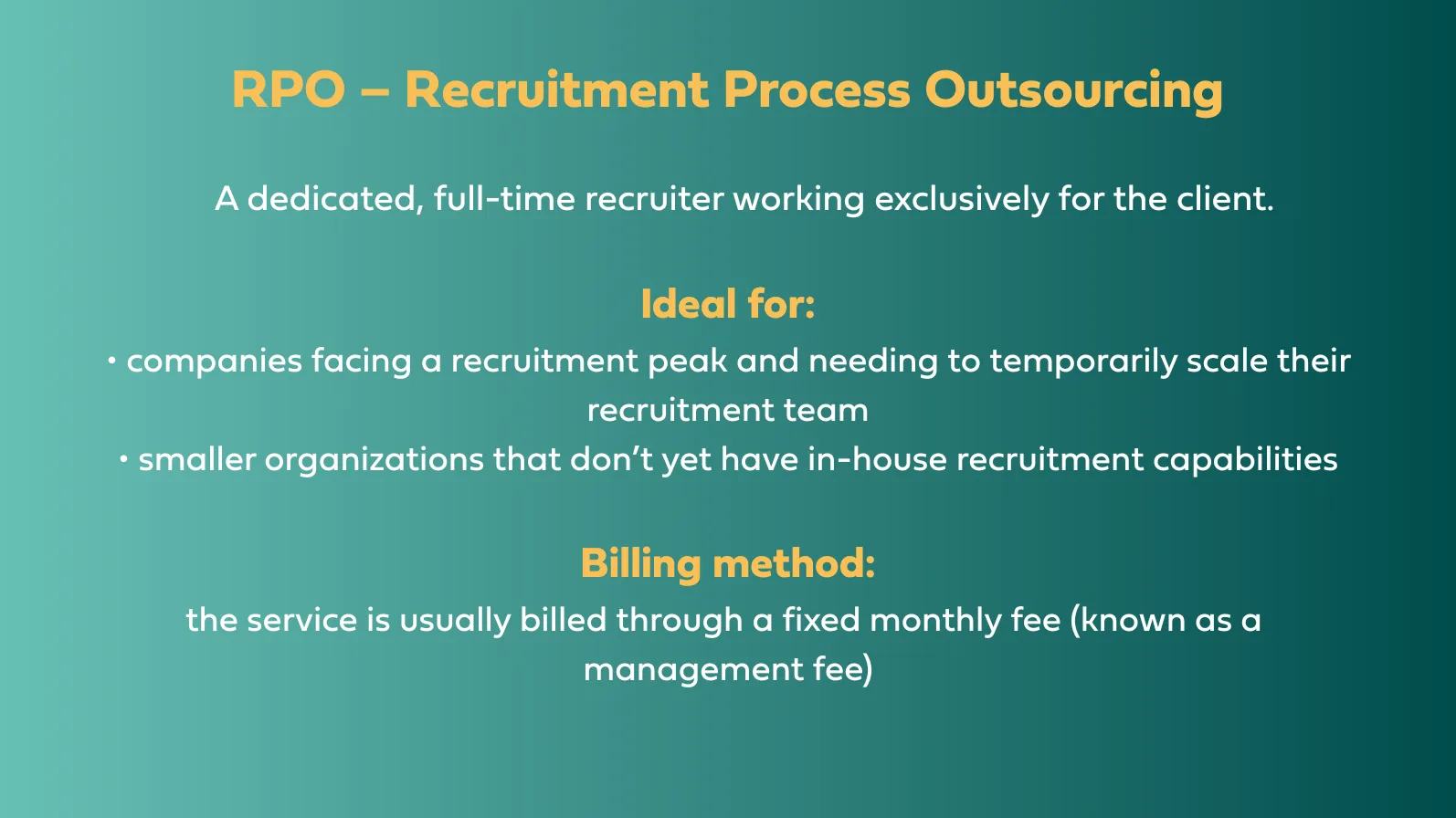
Recruitment Process Outsourcing (RPO) is a form of recruitment outsourcing in which a company receives a dedicated recruiter or an entire team of recruiters working full-time or part-time exclusively for them. Although formally employed by a recruitment agency, the RPO recruiter becomes an integral part of the client’s internal HR team: they use the company’s email domain, access internal tools, communicate with Hiring Managers, represent the company to candidates, and actively participate in daily recruitment operations.
This solution covers the full recruitment process – from defining hiring strategies and creating job ads, through sourcing, pre-screening, and interviews, all the way to candidate recommendations, offer negotiations, and onboarding support. The RPO recruiter can also help analyze and optimize recruitment processes, standardize candidate communication, and implement recruitment tools.
In practice, it means full integration of the recruiter into the client’s team without the need to create a new in-house position, conduct onboarding from scratch, or invest in additional tools. The company gains flexible access to a specialized expert who knows the market, acts fast, and understands the specific needs of Hiring Managers.
Advantages of RPO
1. End-to-end management of the entire recruitment process
RPO goes beyond sourcing – it’s a full takeover of recruitment responsibilities. The dedicated recruiter handles all stages: helping build a hiring strategy, crafting job descriptions, actively sourcing and selecting candidates, making recommendations, and supporting the offer and hiring process. They may also assist with onboarding and report on key recruitment metrics. This allows the internal HR team to focus elsewhere while a seasoned partner runs the entire process.
2. IT industry expertise from the recruitment agency
With RPO, you gain not only a tech recruiter but also the knowledge and best practices of the entire IT recruitment agency behind them. That means support in technically demanding hires, deep market insight, the ability to quickly verify skills, and access to proven tools and talent databases. An experienced partner understands the nuances of IT hiring – from DevOps and Data roles to system architects and can tailor strategies accordingly.
3. Scalability and process optimization
One of RPO’s biggest advantages is flexibility. You can engage an RPO recruiter for a specific timeframe – during a hiring spike or for a major project and scale up or down as needed. The agency brings proven processes and tools – ATS platforms, candidate evaluation methods, reporting systems – enabling real optimization of cost, time, and quality. No need to build recruitment structures from scratch – just leverage the partner’s ready-to-go expertise.
Challenges of RPO
1. Implementation takes time
Although RPO improves recruitment in the long run, it requires preparation upfront. The recruiter needs to get familiar with your organization’s culture, team structure, communication style with Hiring Managers, and internal systems. This onboarding takes time – especially for companies without standardized processes or those operating in fast-paced environments. RPO success depends on building trust and efficient decision-making paths early on.
2. The recruiter must be a good fit for your company
Not every recruiter is right for every company – even experienced ones. In an RPO setup, the recruiter becomes your employer brand’s ambassador, so alignment with your working style, communication standards, and values is critical. Industry familiarity (e.g., software house vs. fintech), technical understanding, and soft skills such as autonomy, proactivity, and stakeholder management can make or break the collaboration. That’s why it’s crucial to ensure the agency allows input into who takes on the RPO role and offers flexibility if a change is needed.
Who is it for?
RPO is an ideal solution for companies that need comprehensive, long-term recruitment support but lack sufficient in-house resources. It works well for mid-sized and large organizations scaling teams rapidly, as well as for tech companies expanding into new markets, opening new offices, or launching large-scale IT projects.
It’s also a great fit for startups, scale-ups, or businesses without an HR department that want to avoid the cost of hiring an in-house recruiter but still need an expert close to the business who can take full ownership of recruitment processes.
HR departments that are overwhelmed by the number of open roles also benefit from RPO as a way to temporarily relieve pressure and speed up hiring without having to expand the internal team. Plus, the flexibility of the model means it can easily scale up or down based on current recruitment needs.
Example: how RPO works in practice
A Scandinavian tech company entering the Polish market needed to build an entire team from scratch with no local HR structure and no prior experience in Polish recruitment. They needed fast, professional, and end-to-end recruitment support.
Instead of building an internal HR department, they partnered with a recruitment agency under the RPO model. The agency provided a dedicated recruiter who became fully embedded in the company’s daily operations – recommending candidates, co-creating hiring strategies, supporting Hiring Managers, advising on job communication, and tailoring actions to the realities of the Polish IT market.
Thanks to a smooth recruiter onboarding and quick rollout of the collaboration model, the company saw results within the first few weeks – not only in the form of hires but also improved communication and faster internal decision-making.
How is it billed?
RPO is typically a medium-to long-term service billed through a monthly management fee. The fee depends on the scope of work, number of roles, and recruiter seniority.
Some clients opt for a hybrid model that includes a fixed base fee plus a variable componentnsuch as a success fee for each hired candidate. This flexibility allows the RPO setup to be tailored to the scale and nature of the company’s recruitment needs.
You can learn more about this service in our article: What is RPO recruitment and when is it worth using?
Contracting – flexibility in collaboration models
Due to rising labor costs, prolonged hiring processes, and critical talent shortages in many international markets, companies increasingly seek alternative solutions to quickly access specialized IT expertise. As a result, many global organizations are turning to IT recruitment in Poland, leveraging flexible cooperation models such as contracting.
How does it work?
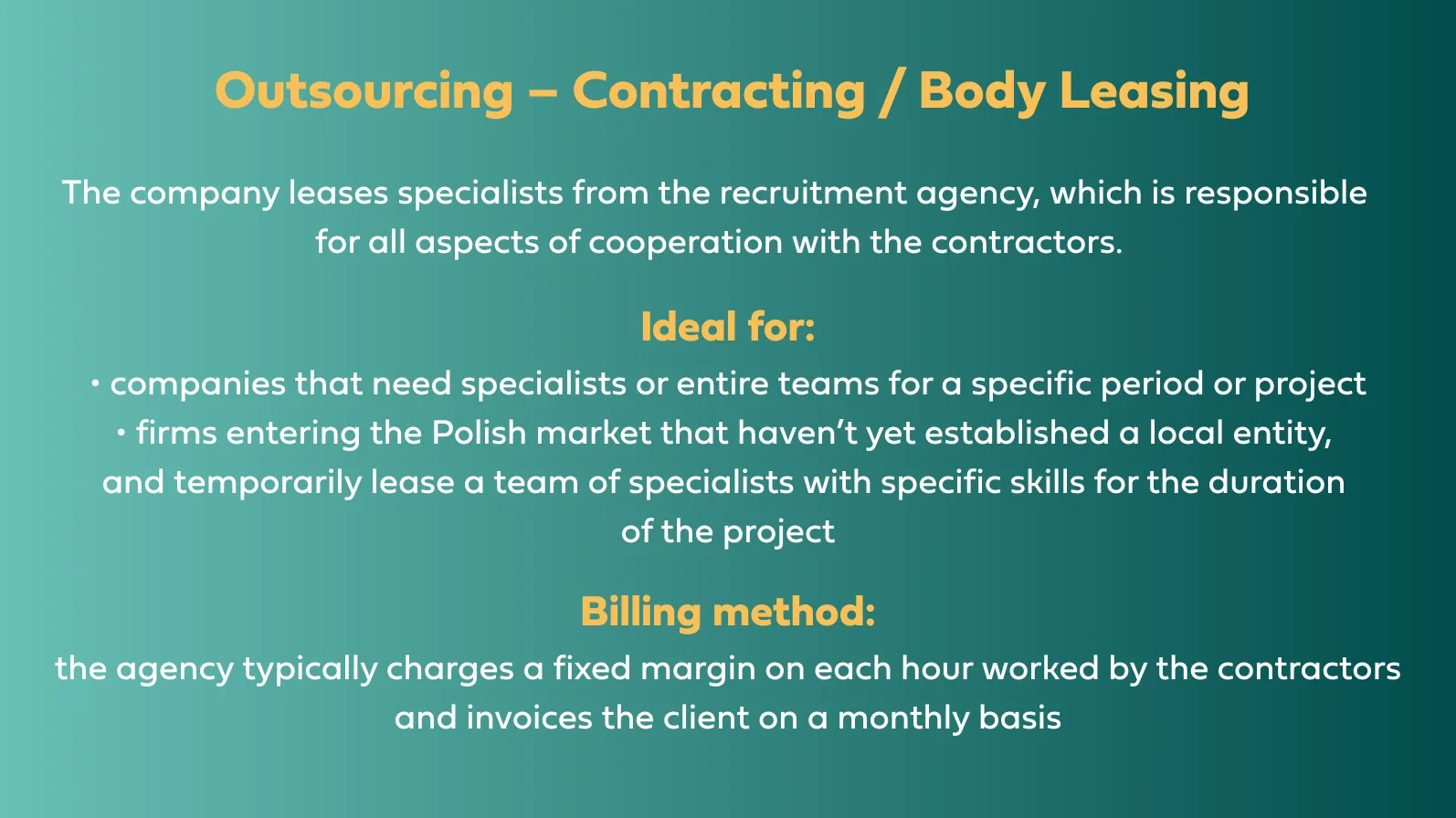
Contracting (also known as Body Leasing) is a cooperation model in which a company leases IT specialists from a recruitment agency for a specific period – usually tied to a particular project or product development phase. The agency handles all formalities related to employment: contracts, payroll, taxes, benefits, and, if needed, contractor replacement. The client receives a ready-to-work expert without having to create a new full-time position or burden the internal HR team.
This model allows for an immediate team boost without lengthy recruitment processes or long-term commitments.
Advantages of contracting
1. Fast access to qualified IT specialists
IT recruitment agencies have large databases of pre-vetted contractors – often previously engaged in other projects. This means clients can quickly reinforce their teams with professionals who have specific skill sets (e.g., DevOps, React frontend, SAP integration experts), often within just a few days. This is especially valuable for time-sensitive projects or sudden staff shortages.
2. Minimal involvement in administrative processes
All legal and administrative responsibilities lie with the agency – from contracts to payments to termination of cooperation if needed. The client doesn’t need to open a full-time position, onboard the contractor into HR systems, or worry about compliance. They can focus entirely on delivering the project.
Disadvantages of contracting
1. Lower integration with company culture
Since contractors often work remotely, temporarily, and for multiple clients simultaneously, their engagement with company culture may be limited. This can make it harder to build long-term team relationships or involve them in internal initiatives such as mentoring or development programs.
2. Higher short-term hiring costs
Speed and flexibility come at a price. Hourly or daily rates for contractors are typically higher than the equivalent cost of a full-time employee. Additionally, the agency adds a margin. However, for fixed-term projects, this model may still be more cost-effective than hiring in-house.
Who is it for?
Contracting is ideal for companies that:
- Are executing time-sensitive or intensive IT projects
- Need specialists with very specific or rare skill sets
- Want to scale project teams without opening permanent roles
- Operate internationally and need alternatives to local hiring (e.g., a U.S.-based company working with Polish IT talent without setting up a legal entity)
It’s also a great solution for product-based organizations that periodically ramp up development work and need to “add hands to the code” fast without the administrative overhead.
Example: contracting in practice
A U.S. tech company planning to scale its software project rapidly was seeking alternatives to local hiring. With rising labor costs and a talent shortage in the American IT market, they expanded their search and ultimately chose Poland – well known for its high-quality engineering talent.
To avoid setting up a local entity and navigating complex legal requirements, the company opted for a contracting model. They leased a team of IT specialists through a recruitment agency for the project’s duration. The agency acted as both provider and operational partner – handling contracts, payments, compliance, and any necessary team changes.
This allowed the company to focus solely on product development while having immediate access to experienced engineers without the burden of permanent hiring or administration. The flexible collaboration model made it easy to adjust resources based on project demands, improving operational efficiency and accelerating delivery timelines.
How is it billed?
Contracting is usually billed on an hourly or monthly basis. The recruitment agency charges a predefined margin on top of the contractor’s rate. In practice, the client pays for each hour worked, without having to settle directly with the specialist.
Some agencies present the total cost of service, while others are more transparent –clearly showing the contractor’s rate and the agency’s fee. In the latter case, the client often has the opportunity to negotiate rates directly with the contractor, providing better control over the budget.
Let me know if you’d like this translated article formatted for web, PDF, or presented as part of a comparative overview alongside the Success Fee and RPO models.
It’s important to keep in mind that contractor rates are typically higher than the cost of full-time employment. This is a natural trade-off for greater flexibility, faster availability, and the fact that the agency assumes full responsibility for all formalities and the risks related to turnover or the need to replace a contractor during the project.
Which recruitment model should you choose?
There’s no one-size-fits-all recruitment model that works for every situation. The right form of support should be based on your business needs, stage of growth, available resources, and the type of roles you’re hiring for. Below is a simplified guide to help you match the right solution to your case:
Success Fee – when you want results without risk
This is the best choice if you only want to pay for outcomes – i.e., successful hires. It’s ideal for filling individual, hard-to-close roles or when your internal HR team is overloaded and you need external support without a long-term commitment. A great fit for companies that need to react flexibly to recruitment needs without freezing their budget.
RPO – when you need long-term, comprehensive support
This model is best suited for situations where recruitment is an ongoing and strategic process. If you’re planning rapid growth, opening a new office, or want to streamline and standardize your processes, RPO provides you with real, embedded support. A dedicated external recruiter becomes a member of your team and can take full ownership of the recruitment process – from A to Z.
Contracting – when you need to quickly strengthen your team
Contracting is made for companies running time-bound IT projects or in urgent need of specific skill sets. No permanent hiring, no red tape – just flexible billing and rapid onboarding of experts. It’s a great option for software houses, MVP-stage startups, product-scaling teams, or companies without a local HR presence.
Ultimately, there’s no universal recruitment model that’s perfect for everyone. Each approach—Success Fee, RPO, or Contracting—offers distinct advantages depending on your specific situation. Choosing the right IT recruitment agency in Poland depends on clearly understanding your business needs, growth stage, and available resources. Taking the time to evaluate these factors will help you select the ideal partner and collaboration model for your IT recruitment challenges.
How to make the right choice?
Each model has its pros and cons – the key is understanding your priorities and constraints. Only then should you start talking to potential recruitment partners. When evaluating an agency, don’t just look at their offer – also consider their way of working, industry expertise, and communication approach. Choosing the right IT recruitment agency in Poland depends on clearly understanding your business needs, growth stage, and available resources. Taking the time to evaluate these factors will help you select the ideal partner and collaboration model for your IT recruitment challenges.
Need help choosing the right model or partner?
Get in touch with us – we’ll be happy to advise you on the best form of cooperation for your specific hiring challenges.



 12 MIN


