



In this article, you will find information about:
- Is the number of CVs the best success metric?
- The 3 most important performance indicators of a job posting
- How to improve the effectiveness of a job posting and what role EVP can play in that
- Is it worth seeking support from a recruitment agency?
In the IT recruitment world, we often hear statements like: “We’ve got tons of CVs!” or “We already have 38 applications within an hour!” At first glance, this may seem like a success — candidates are reacting, the job ad is working. But does the number of applications really translate into a high-quality recruitment process and successful hires?
The effectiveness of a job posting is not about collecting the highest number of CVs, but about how well those applications match the organization’s needs. IT recruitment today is much more than just gathering CVs — it’s a strategic approach to talent acquisition, process optimization, and effective candidate selection.
Monitoring key metrics and adjusting actions to a dynamic market not only speeds up recruitment but, more importantly, helps to hire the best specialists.

Challenges Related to Job Posting
1. Selection Problem
A large number of applications can be just as big a challenge as having too few. In recent months, following numerous layoffs in the IT industry, many candidates are applying for positions for which they do not meet even the minimum requirements. It’s natural — in difficult times, people are looking for various opportunities.
However, for recruiters, this means hundreds of CVs to review. In such situations, it’s easy to face:
- Time overload – screening applications takes an enormous amount of time.
- Risk of missing the best candidates – top talent can get lost in a pile of less relevant applications.
- Delays in the process – candidates with competing offers may withdraw before the recruiter even reaches out.
An excessive number of applications, especially from unqualified candidates, significantly prolongs the entire hiring process, and high-quality candidates may leave the market before the company makes a decision.
That’s why streamlining the selection process is crucial — for example, by formulating more precise job postings, using additional filters, or tools that support automated application screening.
It may also be worth considering working with an IT recruitment agency, which can take over the most time-consuming stages — from CV screening to initial interviews — allowing the in-house recruitment team to focus on final decisions.
2. Too Much Competition in the IT Market
The IT job market is extremely competitive, and top candidates often have multiple offers on the table at the same time.
If the recruitment process takes too long or the offer is not aligned with market expectations, companies lose IT specialists to faster, more flexible employers.
That’s why it’s essential to take actions that improve the effectiveness of recruitment channels and optimize key performance metrics.
How to stand out from the competition and attract the best candidates?
- Optimize the recruitment process to make it as short and efficient as possible.
- Align the offer and salary with market realities.
- Actively search for candidates beyond just posting job ads, e.g., through direct search.
In IT recruitment, it’s not about quantity but quality — the effectiveness of the recruitment funnel is measured not just by the number of applications but, above all, by successful hires.
To effectively compete for IT specialists, companies should focus on streamlining the recruitment process, adjusting offers to market standards, and actively sourcing talent. This is the only way to improve recruitment effectivenessand attract top experts in the industry.
3. Poorly Matched Job Ad Distribution Channels
One of the most common issues in IT recruitment is ineffective distribution of job postings.
If a job ad reaches the wrong target group, it may generate a large number of applications from candidates who do not meet the requirements. This not only extends the hiring process but also burdens the HR team with unnecessary screening work.
How to ensure that a job ad reaches the right audience?
- Choose the right platforms for posting jobs — e.g., Stack Overflow, GitHub, Discord, or specialized LinkedIn groups.
- Test different ad formats and analyze which sources deliver the best results.
- Consider partnering with a recruitment agency that has access to a network of contacts and a database of passive candidates.
The success of a job posting is not just about the number of CVs — what matters is their quality, how well the company’s value proposition is communicated, and the competitiveness of the offer. Optimizing these elements helps attract top IT talent more effectively.
How to Measure the Effectiveness of Job Ads?
1. Time-to-hire
Time-to-hire is one of the most important efficiency metrics in IT recruitment, measuring how much time passes from posting the job ad to hiring the candidate.
A recruitment process that takes too long can negatively affect the company, leading to:
- Losing top candidates,
- Increased recruitment costs,
- Delays in project delivery.
If the recruitment process is too slow, it may indicate:
- Overload caused by too many applications – lack of effective screening leads to long hours spent reviewing CVs, slowing down the entire process.
- Problems with candidate-job match – if the applications don’t meet expectations, this could mean poorly defined job requirements or an imprecise job ad.
- Ineffective selection strategy – unclear recruitment stages and delays in decision-making can lengthen the process and increase the risk of losing IT specialists to competing offers.
Thus, analyzing time-to-hire helps determine how efficient your recruitment process is and whether your channels and sources of recruitment support quick hiring.
Time-to-hire = Date of acceptance of the job offer – Date of application
Average time-to-hire for different IT positions:
source: www.bigglo.pl
- Backend Developer: 35 days
- Frontend Developer: 30 days
- DevOps Engineer: 32 days
- Tester oprogramowania: 28 days
2. Recruitment Funnel
The recruitment funnel is a key tool in IT recruitment that visualizes how candidates move through each stage of the hiring process. It helps you monitor performance metrics and identify where in the process you might be losing potentially valuable candidates.
Analyzing the recruitment funnel allows you to understand:
- How many candidates move from one stage to the next.
- How many applications turn into interviews.
- What percentage of interviews result in final offers.
If you notice that a large number of candidates are dropping out in the early stages, it may indicate that:
- Your job ad isn’t attracting the right candidates – perhaps the job description is too vague, or the salary and requirements are misaligned with IT market expectations.
- Your sourcing channels are ineffective – analyzing the effectiveness of sourcing channels can help determine whether to invest more in job boards, direct search, or other methods.
- Candidate screening takes too long – if the hiring process drags on, IT candidates may accept offers from faster-moving competitors.
To improve the recruitment funnel and increase your chances of hiring top talent, it’s essential to regularly analyze key performance metrics and optimize each stage of the process.
3. IT Candidate Hiring Sources
Understanding where your hired IT specialists are coming from is a critical metric for evaluating recruitment effectiveness. It helps identify which sourcing channels are actually delivering results.
If your analysis shows that only a small percentage of hires come from job postings, this may indicate that:
- The content of your job ads is not precise or attractive enough for your target group.
- Your recruitment channels are underperforming and need optimization.
- Competitors are reaching top candidates more effectively through more proactive recruitment methods.
The effectiveness of sourcing channels has a direct impact on the quality of your hires. Companies that rely solely on job postings may miss out on the best candidates. That’s why it’s crucial to track recruitment metrics, analyze the data, and adapt your strategy to the dynamic IT talent market.
Job Posting Effectiveness and EVP
The success of a job posting is not just about the number of applications — it’s also about how well it communicates your Employee Value Proposition (EVP).
EVP is the unique set of values that sets your company apart from competitors and attracts top specialists. IT candidates aren’t just looking for a high salary — they care about company culture, growth opportunities, and what day-to-day work looks like.
A strong job ad should clearly highlight these elements to engage the right candidates and motivate them to apply.
Research data from LinkedIn shows that a strong employer brand significantly influences candidates’ decisions. Companies that are perceived as attractive places to work attract twice as many applications, and as many as 75% of candidates check an employer’s reputation before applying.
What Makes a Well-Crafted Job Ad?
A well-crafted job ad should clearly communicate the following:
- What the company offers to its employees – such as professional growth, flexibility, concrete benefits, job stability, access to modern technologies, or the opportunity to make a real impact on products.
- Why candidates should join this specific team – whether the company focuses on innovation, supports work-life balance, offers remote work options, or has a unique work culture.
- What values set the company apart from competitors – tech companies are competing for IT talent, so it’s crucial to stand out with more than just competitive salaries. Candidates want to know the company’s mission, leadership style, and approach to technology.
- What career paths and growth opportunities are available – IT specialists expect ongoing development. It’s worth highlighting whether the company offers training programs, education budgets, or opportunities to work on diverse and challenging projects.
- What the real work looks like and what candidates can expect – instead of vague phrases, provide concrete examples of typical projects, working methodologies (e.g., Agile, Scrum), and technologies used by the team.
Professional recruitment agencies, such as Team Up IT Recruitment, ensure that recruitment adverts and messages stand out from the competition by clearly presenting EVP values and attracting the right candidates.
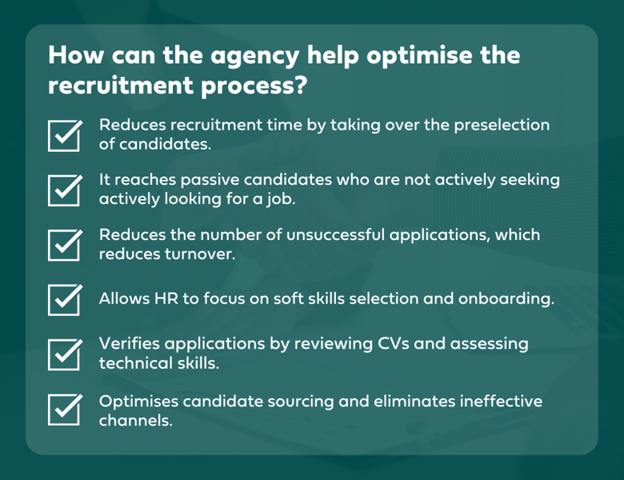
How Can a Recruitment Agency Optimize the Hiring Process?
Partnering with an IT recruitment agency can significantly improve key recruitment metrics and increase the overall effectiveness of your hiring funnel. Here are the main benefits:
- Faster time-to-hire – The agency takes over the time-consuming pre-selection process, delivering only carefully matched candidates, which significantly reduces the recruitment timeline.
- Access to passive candidates – Most top IT experts don’t browse job ads. Through direct search, recruiters reach out to them directly, increasing your chances of hiring the best talent.
- Professional application screening support – Experienced recruiters perform thorough CV reviews and technical assessments, ensuring you receive only candidates who truly meet the requirements.
- Focus on high-quality selection and onboarding – Instead of spending time on sourcing and initial interviews, your internal HR team can focus on evaluating soft skills, cultural fit, and ensuring a smooth onboarding process.
- Fewer mismatched applications – Agencies deliver candidates who have already passed initial verification, speeding up the process and reducing the risk of candidate drop-off during recruitment.
- Detailed reports and recruitment funnel analytics – Agencies provide insights into the performance of each recruitment stage, helping to identify bottlenecks and further optimize your hiring process.
- Optimization of sourcing channels – Agencies analyze and advise on which channels bring the best candidates, helping to avoid unnecessary spending on ineffective platforms.
By partnering with an experienced IT recruitment agency, companies can improve efficiency, shorten time-to-hire, and attract top talent, while allowing internal HR teams to focus on what matters most.
Want to learn more? Check out our article: Will an IT recruitment agency provide you with good candidates?
Summary
The effectiveness of IT job postings is not about the number of CVs collected but about the quality of applications, the length of the recruitment process, and the final results.
Regularly monitoring key metrics such as time-to-hire, recruitment funnel performance, and candidate sourcing channels will help you better understand the effectiveness of your recruitment efforts and adjust them to the specifics of each role.
There is no one-size-fits-all solution — effective recruitment requires flexibility and a smart combination of different sourcing methods. For some roles, job boards may work well; other positions may require active sourcing, and for particularly challenging searches, partnering with a recruitment agency can be the key to success.
If you want to improve the effectiveness of your job ads, shorten time-to-hire, and increase candidate quality, it’s worth exploring different talent acquisition strategies.
At Team Up IT Recruitment, we help companies successfully reach IT specialists and choose the best recruitment methods tailored to their specific needs.
Get in touch with us to find out how we can support your company in attracting top IT talent!


 12 MIN


